
Mathematics can be both fantastic and challenging at the same time. Specially in class 10 when students have to give board paper. So our NCERT class 10 Mathematics Chapter 13 Statistics notes will provide conceptual clarity to the students. It will work like a bridge for students between class room theory lecture and solving exercise at home.
These Class 10 Chapter 13 Statistics Notes is a masterstroke for students who want to pursue a career in science, like becoming an engineer, scientist etc. Most of the concept given in class 11 maths have already been introduced in class 10 maths. So these notes are also the foundation of class 11 math.
Class 10 Maths Chapter 13 Statistics Notes
Chapter 12: Surface Areas and Volumes Notes
Chapter 14: Probability Notes
Below we have also given most important topics of NCERT Class 10 Mathematics chapter 13 Statistics Notes. Students should revise these notes regularly to remember the chapter properly.
Important Topic of Statistics
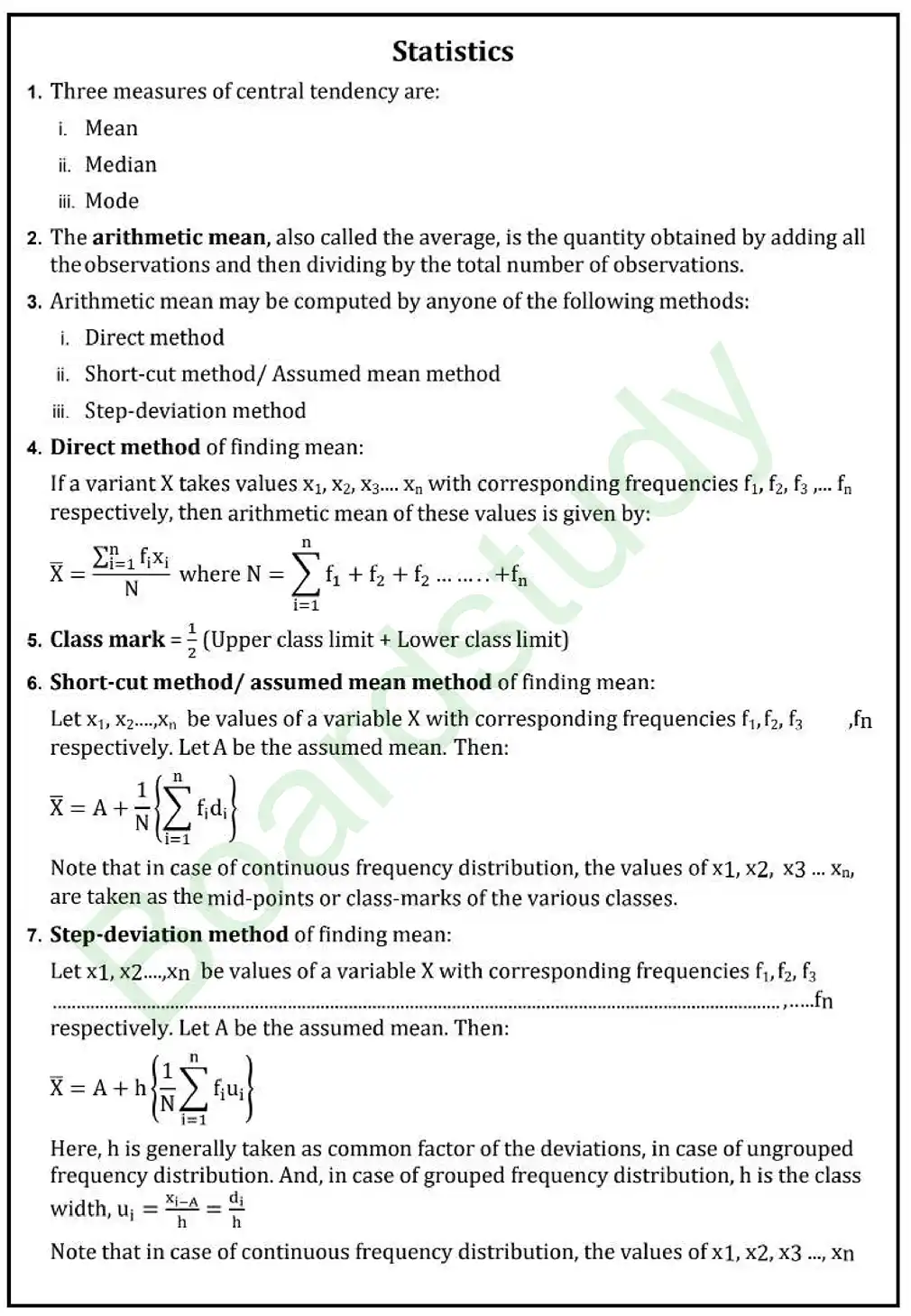
The step deviation method will be convenient to apply if all the deviations (d’s) have a common factor.
If class mark obtained, are in decimal form, then step deviation method is preferred to calculate mean.
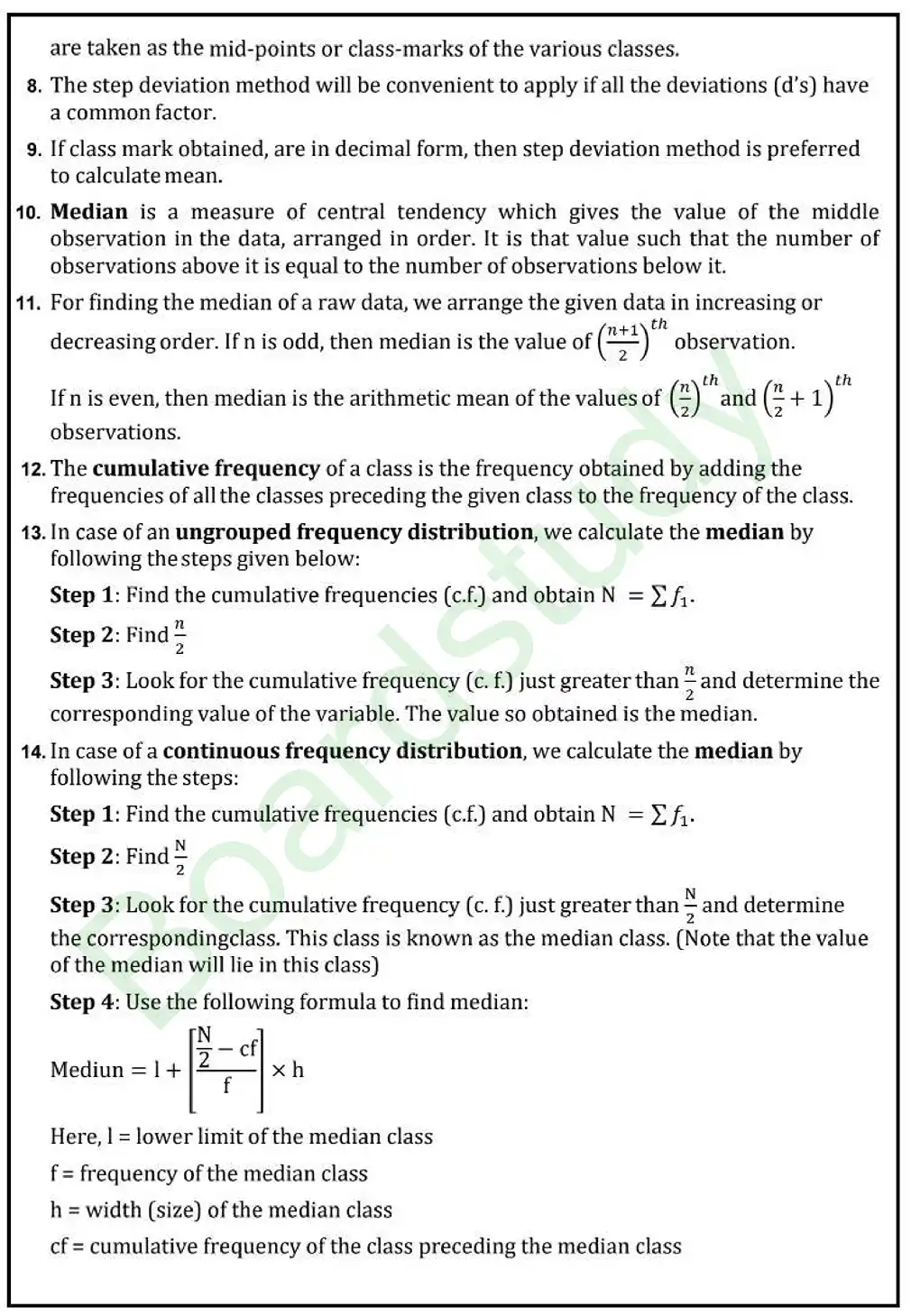
Median is a measure of central tendency which gives the value of the middle observation in the data, arranged in order. It is that value such that the number of observations above it is equal to the number of observations below it.
For finding the median of a raw data, we arrange the given data in increasing or
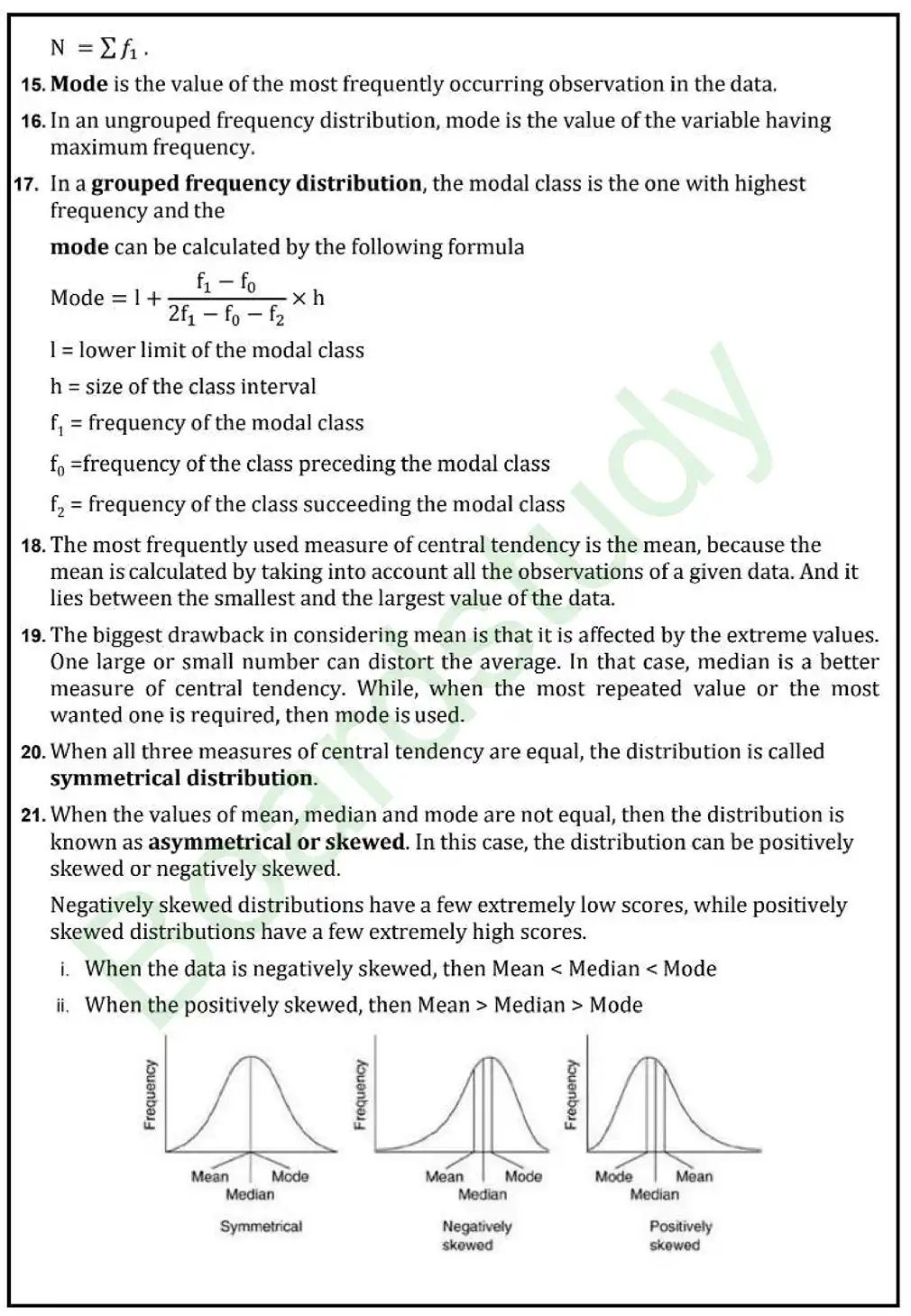
The most frequently used measure of central tendency is the mean, because the mean is calculated by taking into account all the observations of a given data. And it lies between the smallest and the largest value of the data.
The biggest drawback in considering mean is that it is affected by the extreme values. One large or small number can distort the average. In that case, median is a better measure of central tendency. While, when the most repeated value or the most wanted one is required, then mode is used.
When all three measures of central tendency are equal, the distribution is called symmetrical distribution.
When the values of mean, median and mode are not equal, then the distribution is known as asymmetrical or skewed. In this case, the distribution can be positively skewed or negatively skewed.