
Mathematics can be both fantastic and challenging at the same time. Specially in class 10 when students have to give board paper. So our NCERT class 10 Mathematics chapter 14 Probability notes will provide conceptual clarity to the students. It will work like a bridge for students between class room theory lecture and solving exercise at home.
These Class 10 Chapter 14 Probability Notes is a masterstroke for students who want to pursue a career in science, like becoming an engineer, scientist etc. Most of the concept given in class 11 maths have already been introduced in class 10 maths. So these notes are also the foundation of class 11 math.
Class 10 Maths 14 Probability Notes

Chapter 13: Statistics Notes
Below we have also given most important topics of NCERT Class 10 Mathematics 14 Probability Notes. Students should revise these notes regularly to remember the chapter properly.
Important Topic of Probability
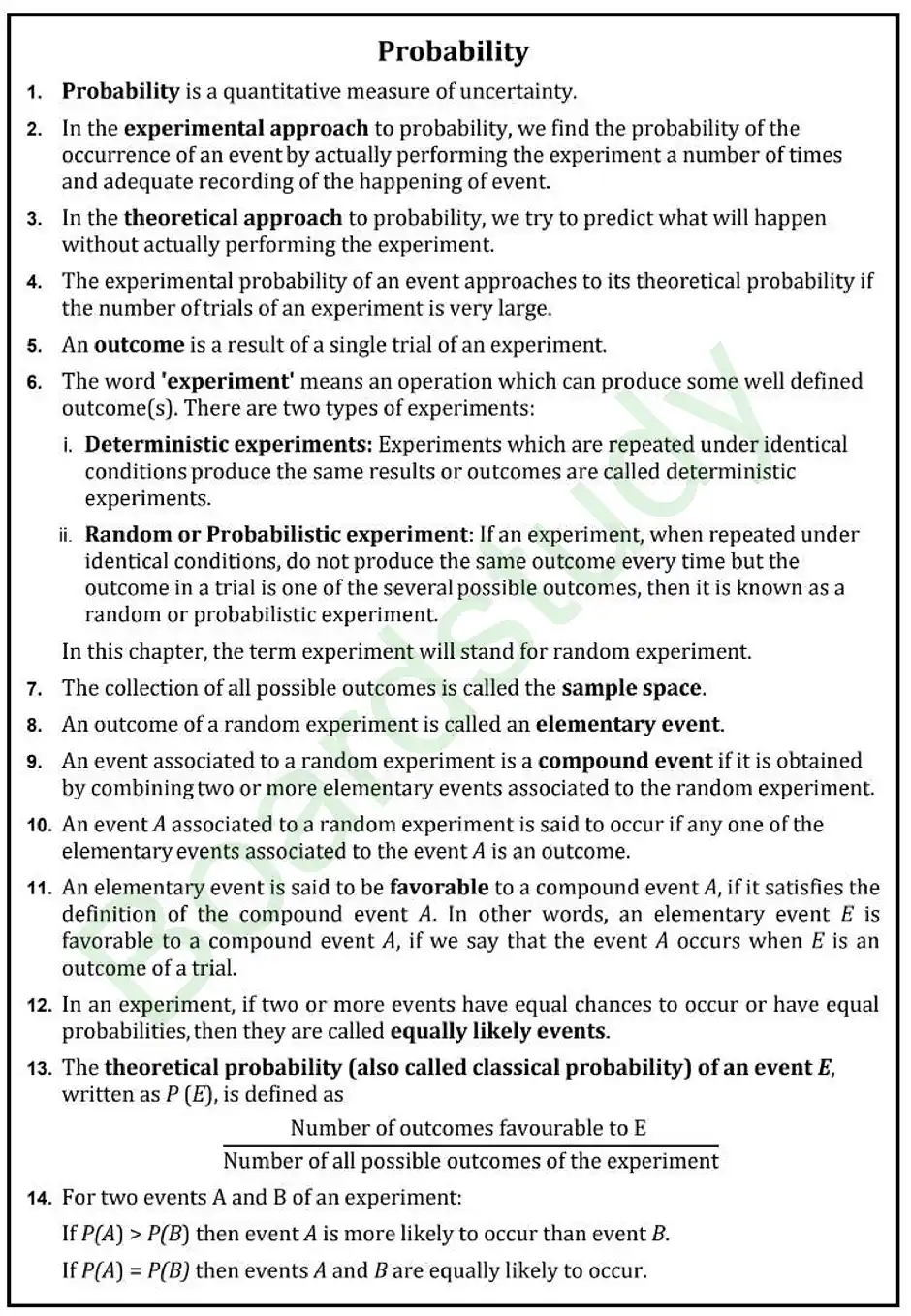
1. Probability is a quantitative measure of uncertainty.
2. In the experimental approach to probability, we find the probability of the occurrence of an event by actually performing the experiment a number of times and adequate recording of the happening of event.
3. In the theoretical approach to probability, we try to predict what will happen without actually performing the experiment.
4. The experimental probability of an event approaches to its theoretical probability if the number of trials of an experiment is very large.
5. An outcome is a result of a single trial of an experiment.
6. The word ‘experiment’ means an operation which can produce some well defined outcome(s). There are two types of experiments:
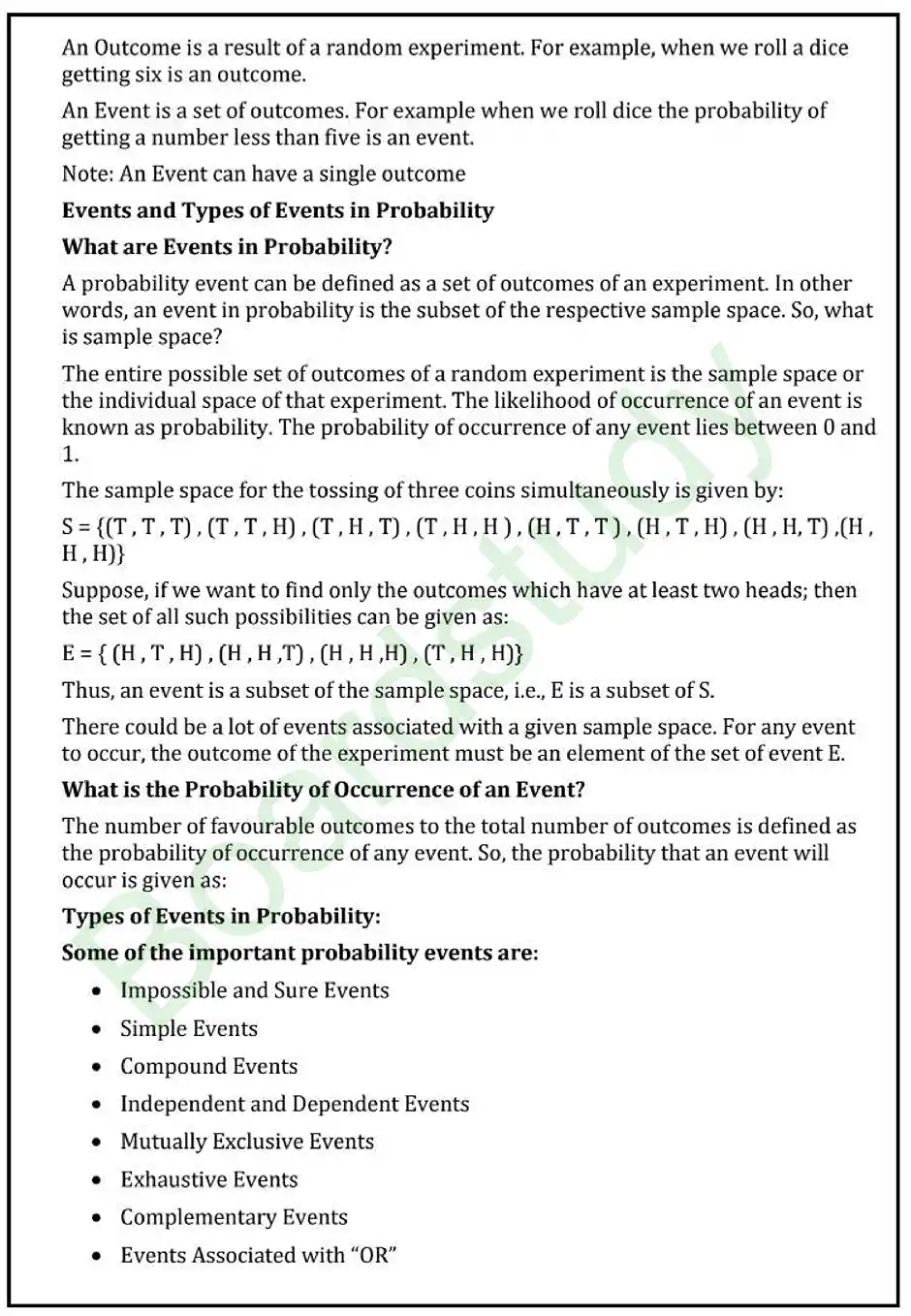
7. The collection of all possible outcomes is called the sample space.
8. An outcome of a random experiment is called an elementary event.
9. An event associated to a random experiment is a compound event if it is obtained by combining two or more elementary events associated to the random experiment.
10. An event A associated to a random experiment is said to occur if any one of the elementary events associated to the event A is an outcome.
11. An elementary event is said to be favorable to a compound event A, if it satisfies the definition of the compound event A. In other words, an elementary event E is favorable to a compound event A, if we say that the event A occurs when E is an outcome of a trial.
12. In an experiment, if two or more events have equal chances to occur or have equal probabilities, then they are called equally likely events.