
BoardStudy given Class 11 Math Chapter 8 Sequences and Series notes according to latest NCERT syllabus to make your study more convenient and easy. We have covered every topic in a simple and easy way so anyone can understand the chapter and perform well in the exam.
Notes are very clean and colourful written by BoardStudy subject matter experts. Every important concept, formula, diagram and derivation is shared in the Sequences and Series notes that will help you solve the problem. By reviewing these notes regularly you will master the Sequences and Series chapter and can score well in exam.
Class 11 Math Sequences and Series Notes PDF
Chapter 7: Binomial Theorem Notes
Chapter 9: Straight Lines Notes
Key Points Sequences and Series
• Sequence
A succession of numbers arranged in a definite order according to a given certain rule is called sequence.
• Finite sequence
Sequence having finite number of terms.
• Infinite sequence
Sequence having infinite number of terms.
• Progression
A sequence whose terms follow certain patterns are called progression.
• Series
If a₁, a₂, a₃, … an is a sequence, then the expression
a₁ + a₂ + a₃ + a₄ + …… + an is called series.
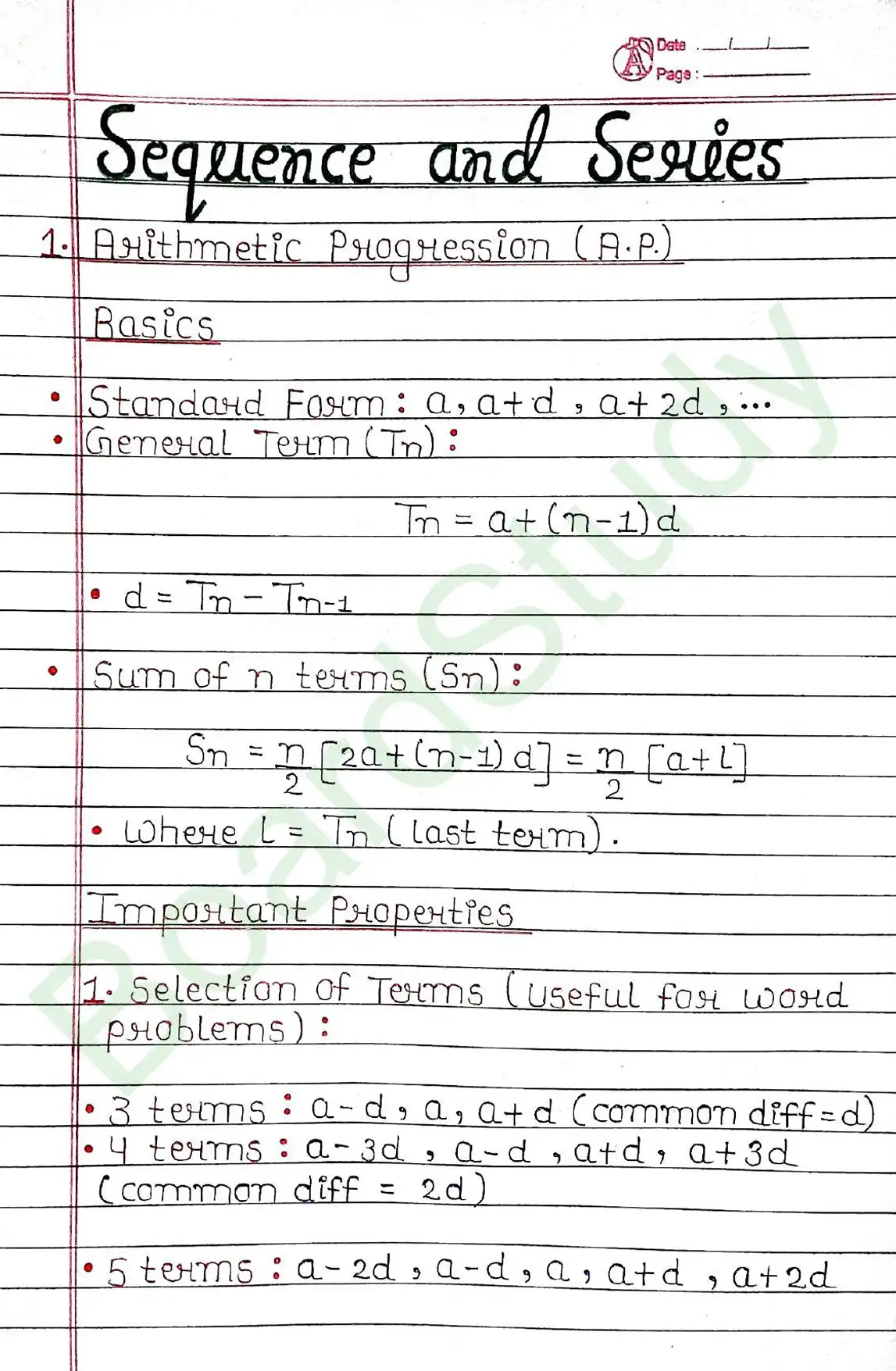
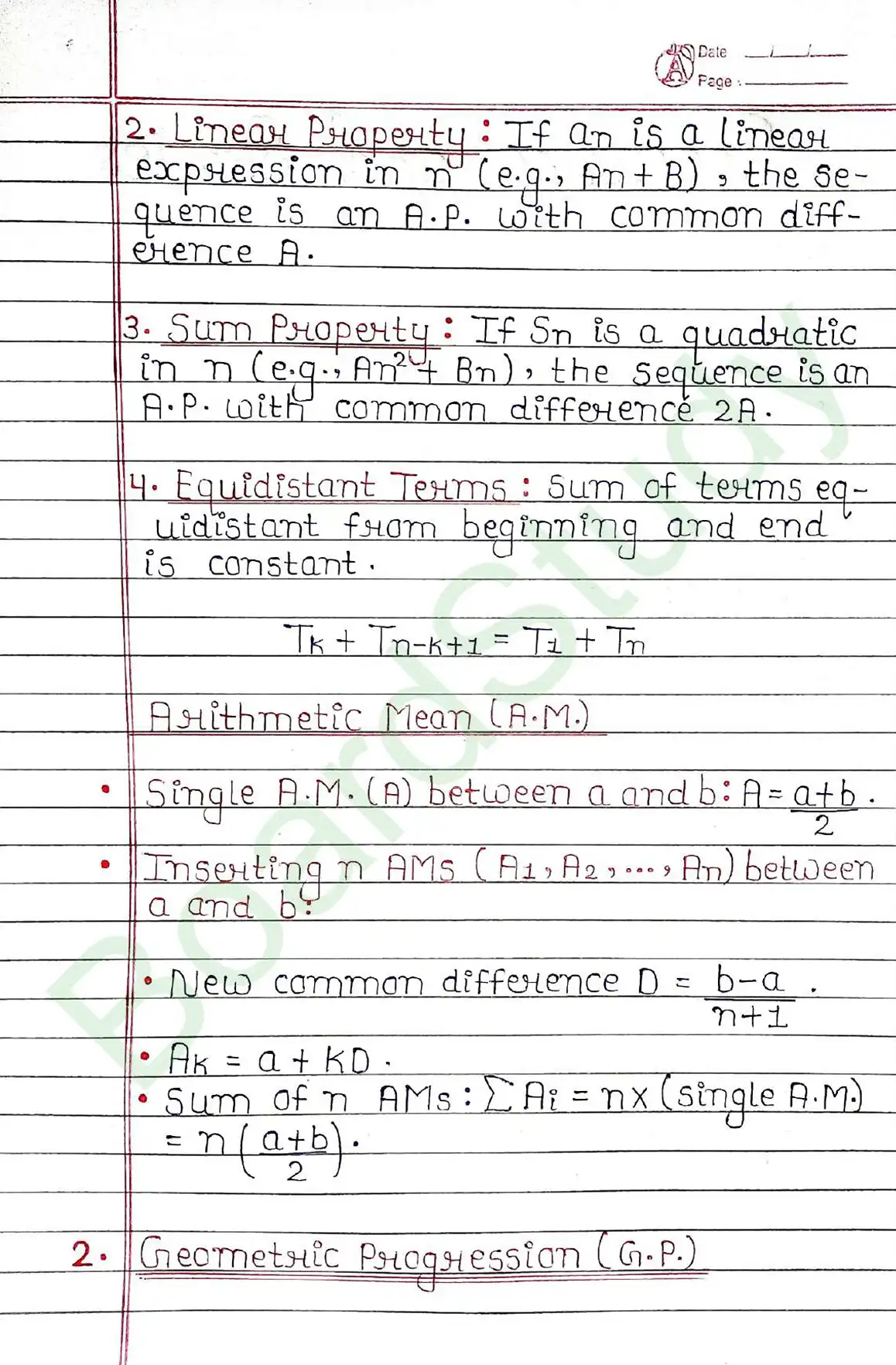
Arithmetic Progression (A.P)
A sequence in which the difference of two consecutive terms is constant, is called arithmetic progression.
We use the following notations for an arithmetic progression:
a – the first term
l – the last term
d – common difference
n – the number of terms
Sₙ – the sum of n terms of A.P
Properties of an A.P:
• If a constant is added to each term of an A.P, the resulting sequence is also an A.P.
• If a constant is subtracted from each term of an A.P, the resulting sequence is also an A.P.
• If each term of an A.P is multiplied by a constant, then the resulting sequence is also an A.P.
• If each term of an A.P is divided by a non-zero constant, then the resulting sequence is also an A.P.
• If a, b and c are three consecutive terms of an A.P then
2b = a + c
• Any three terms of an A.P can be taken as (a − d), a, (a + d).
• Any four terms of an A.P can be taken as (a − 3d), (a − d), (a + d), (a + 3d).