Class 10 Math Chapter 12 Surface Areas and Volumes Solutions

Here, Class 10 Math Chapter 12 Surface Areas and Volumes Solutions are provided. Subject matter experts have created these solutions to help students in their board exam. They have created solutions in such a way that students can revise the entire solutions in very little time and can score good marks in the board exam. Every solution is provided in detail and in very simple language.

Class 10 Math Chapter 12 Surface Areas and Volumes Solutions are very important for board exam. Solving these Surface Areas and Volumes solutions will boost the confidence and students can score better in exam. Solutions are provided according to latest NCERT syllabus. Experts created these step-by-step solutions, which will definitely be helpful for students.

Surface Areas and Volumes Solutions

Exercise 12.1

Exercise 12.2

Chapter 11: Areas Related to Circles Solutions

We have given solutions of all exercise of class 10 math chapter 12. These solutions will be helpful for students understanding core concept of Surface Areas and Volumes.

To understand the chapter thoroughly, it is essential to practice all the questions provided within it, as well as any additional questions. Solving previous years’ question papers also proves to be very helpful in exam preparation. You can also find other study material resources on our website.

Important Questions for NCERT Chapter 12: Surface Areas and Volumes

Question :

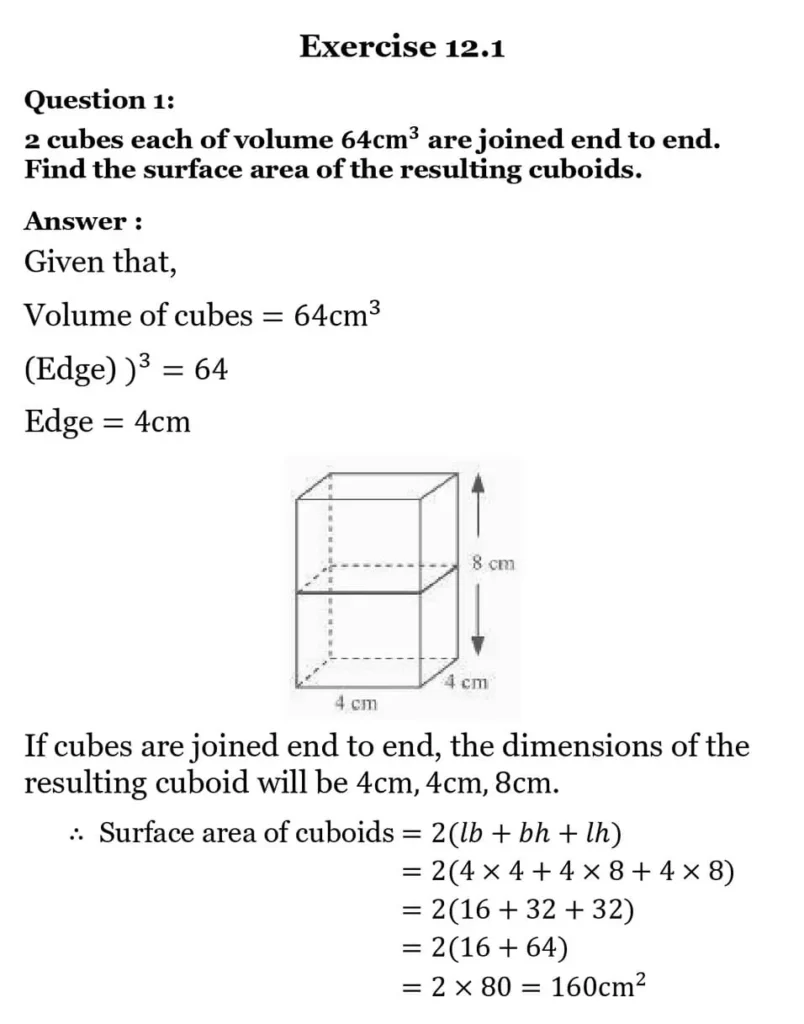
𝟐 𝐜𝐮𝐛𝐞𝐬 𝐞𝐚𝐜𝐡 𝐨𝐟 𝐯𝐨𝐥𝐮𝐦𝐞 64cm3 𝐚𝐫𝐞 𝐣𝐨𝐢𝐧𝐞𝐝 𝐞𝐧𝐝 𝐭𝐨 𝐞𝐧𝐝.𝐅𝐢𝐧𝐝 𝐭𝐡𝐞 𝐬𝐮𝐫𝐟𝐚𝐜𝐞 𝐚𝐫𝐞𝐚 𝐨𝐟 𝐭𝐡𝐞 𝐫𝐞𝐬𝐮𝐥𝐭𝐢𝐧𝐠 𝐜𝐮𝐛𝐨𝐢𝐝𝐬.\begin{array}{l} \textbf{2 cubes each of volume } 64\text{cm}^3 \textbf{ are joined end to end.} \\ \textbf{Find the surface area of the resulting cuboids.} \end{array}

Answer :

Given that,Volume of cubes=64cm3(Edge))3=64Edge=4cm\begin{array}{l} \text{Given that,} \\ \text{Volume of cubes} = 64\text{cm}^3 \\ (\text{Edge}) )^3 = 64 \\ \text{Edge} = 4\text{cm} \end{array}
If cubes are joined end to end, the dimensions of theresulting cuboid will be 4cm, 4cm, 8cm.Surface area of cuboidsamp;=2(lb+bh+lh)amp;=2(4×4+4×8+4×8)amp;=2(16+32+32)amp;=2(16+64)amp;=2×80=160cm2\begin{array}{l} \text{If cubes are joined end to end, the dimensions of the} \\ \text{resulting cuboid will be } 4\text{cm, } 4\text{cm, } 8\text{cm.} \\ \begin{aligned} \therefore \text{Surface area of cuboids} &= 2(lb + bh + lh) \\ &= 2(4 \times 4 + 4 \times 8 + 4 \times 8) \\ &= 2(16 + 32 + 32) \\ &= 2(16 + 64) \\ &= 2 \times 80 = 160\text{cm}^2 \end{aligned} \end{array}

Question :

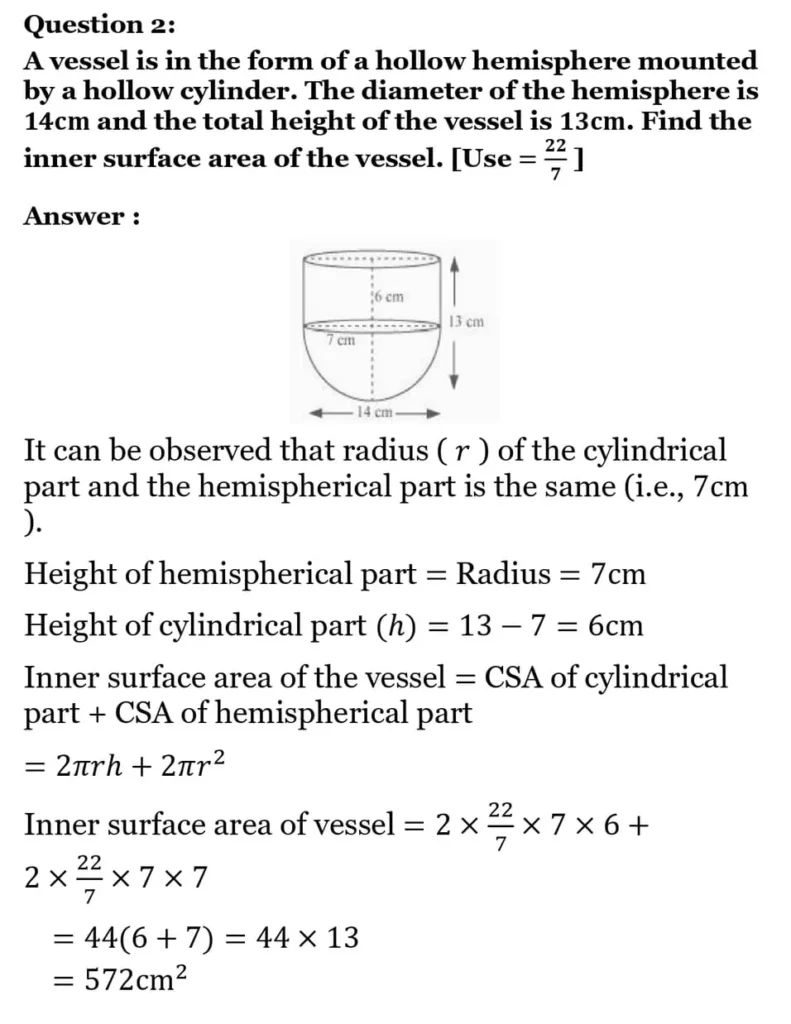
𝐀 𝐯𝐞𝐬𝐬𝐞𝐥 𝐢𝐬 𝐢𝐧 𝐭𝐡𝐞 𝐟𝐨𝐫𝐦 𝐨𝐟 𝐚 𝐡𝐨𝐥𝐥𝐨𝐰 𝐡𝐞𝐦𝐢𝐬𝐩𝐡𝐞𝐫𝐞 𝐦𝐨𝐮𝐧𝐭𝐞𝐝𝐛𝐲 𝐚 𝐡𝐨𝐥𝐥𝐨𝐰 𝐜𝐲𝐥𝐢𝐧𝐝𝐞𝐫. 𝐓𝐡𝐞 𝐝𝐢𝐚𝐦𝐞𝐭𝐞𝐫 𝐨𝐟 𝐭𝐡𝐞 𝐡𝐞𝐦𝐢𝐬𝐩𝐡𝐞𝐫𝐞 𝐢𝐬𝟏𝟒𝐜𝐦 𝐚𝐧𝐝 𝐭𝐡𝐞 𝐭𝐨𝐭𝐚𝐥 𝐡𝐞𝐢𝐠𝐡𝐭 𝐨𝐟 𝐭𝐡𝐞 𝐯𝐞𝐬𝐬𝐞𝐥 𝐢𝐬 𝟏𝟑𝐜𝐦. 𝐅𝐢𝐧𝐝 𝐭𝐡𝐞𝐢𝐧𝐧𝐞𝐫 𝐬𝐮𝐫𝐟𝐚𝐜𝐞 𝐚𝐫𝐞𝐚 𝐨𝐟 𝐭𝐡𝐞 𝐯𝐞𝐬𝐬𝐞𝐥. [𝐔𝐬𝐞 =227]\begin{array}{l} \textbf{A vessel is in the form of a hollow hemisphere mounted} \\ \textbf{by a hollow cylinder. The diameter of the hemisphere is} \\ \textbf{14cm and the total height of the vessel is 13cm. Find the} \\ \textbf{inner surface area of the vessel. } \left[ \textbf{Use } = \frac{22}{7} \right] \end{array}

Answer :

It can be observed that radius (r) of the cylindricalpart and the hemispherical part is the same (i.e., 7cm).Height of hemispherical part=Radius=7cmHeight of cylindrical part (h)=137=6cmInner surface area of the vessel=CSA of cylindricalpart+CSA of hemispherical part=2πrh+2πr2Inner surface area of vessel=2×227×7×6+2×227×7×7=44(6+7)=44×13=572cm2\begin{array}{l} \text{It can be observed that radius } (r) \text{ of the cylindrical} \\ \text{part and the hemispherical part is the same (i.e., } 7\text{cm} \\ \text{).} \\[1ex] \text{Height of hemispherical part} = \text{Radius} = 7\text{cm} \\[1ex] \text{Height of cylindrical part } (h) = 13 – 7 = 6\text{cm} \\[1ex] \text{Inner surface area of the vessel} = \text{CSA of cylindrical} \\ \text{part} + \text{CSA of hemispherical part} \\[1ex] = 2\pi rh + 2\pi r^2 \\[1ex] \text{Inner surface area of vessel} = 2 \times \frac{22}{7} \times 7 \times 6 + \\ 2 \times \frac{22}{7} \times 7 \times 7 \\[1ex] \quad = 44(6 + 7) = 44 \times 13 \\ \quad = 572\text{cm}^2 \end{array}

Leave a Comment

Your email address will not be published. Required fields are marked *