
CBSE class 9 Maths Chapter 2 Introduction to Linear Polynomials is very interesting chapter. Math can be nightmare for some students as it contains complex formula, diagram and involves critical thinking. But some students also enjoy solving complex math problem.
In Introduction to Linear Polynomials Notes students will learn about the x-axis, y-axis, origin, quadrants, ordered pairs, plot and identify points, reflection of points and distance between two points. These concepts will strength the concept and prepare students for upcoming exam.
Introduction to Linear Polynomials Notes
Class 9 Maths Chapter 2 Introduction to Linear Polynomials Notes will help the students to revise the chapter faster and solve real problem. Diagram, chart and graph has given in notes for better understanding the concepts.
Important Topics
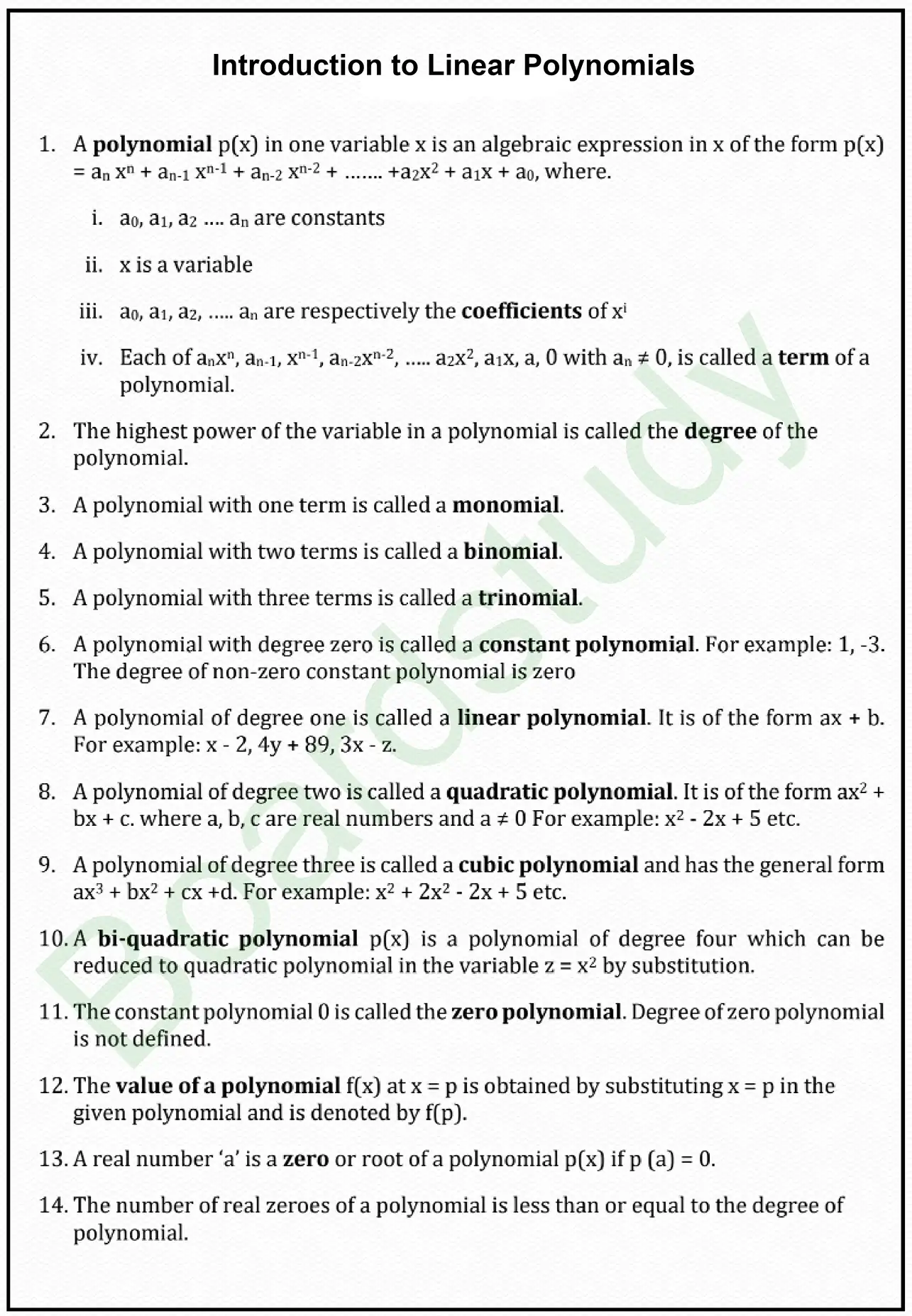
1. A polynomial p(x) in one variable x is an algebraic expression in x of the form p(x) = aₙ xⁿ + aₙ₋₁ xⁿ⁻¹ + aₙ₋₂ xⁿ⁻² + ……. + a₂x² + a₁x + a₀, where.
i. a₀, a₁, a₂ …. aₙ are constants
ii. x is a variable
iii. a₀, a₁, a₂, …. aₙ are respectively the coefficients of xⁱ
iv. Each of aₙxⁿ, aₙ₋₁ xⁿ⁻¹, aₙ₋₂xⁿ⁻², ….. a₂x², a₁x, a₀, 0 with aₙ ≠ 0, is called a term of a polynomial.
2. The highest power of the variable in a polynomial is called the degree of the polynomial.
3. A polynomial with one term is called a monomial.
4. A polynomial with two terms is called a binomial.
5. A polynomial with three terms is called a trinomial.
6. A polynomial with degree zero is called a constant polynomial. For example: 1, -3. The degree of non-zero constant polynomial is zero.
7. A polynomial of degree one is called a linear polynomial. It is of the form ax + b. For example: x – 2, 4y + 89, 3x – z.
8. A polynomial of degree two is called a quadratic polynomial. It is of the form ax² + bx + c. where a, b, c are real numbers and a ≠ 0 For example: x² – 2x + 5 etc.
9. A polynomial of degree three is called a cubic polynomial and has the general form ax³ + bx² + cx + d. For example: x² + 2x² – 2x + 5 etc.