
BoardStudy given Class 11 Math Chapter 11 3D Geometry notes according to latest NCERT syllabus to make your study more convenient and easy. We have covered every topic in a simple and easy way so anyone can understand the chapter and perform well in the exam.
Notes are very clean and colourful written by BoardStudy subject matter experts. Every important concept, formula, diagram and derivation is shared in the 3D Geometry notes that will help you solve the problem. By reviewing these notes regularly you will master the 3D Geometry chapter and can score well in exam.
Class 11 Math 3D Geometry Notes
Chapter 10: Conic Sections Notes
Chapter 12: Limits and Derivatives Notes
Key Points
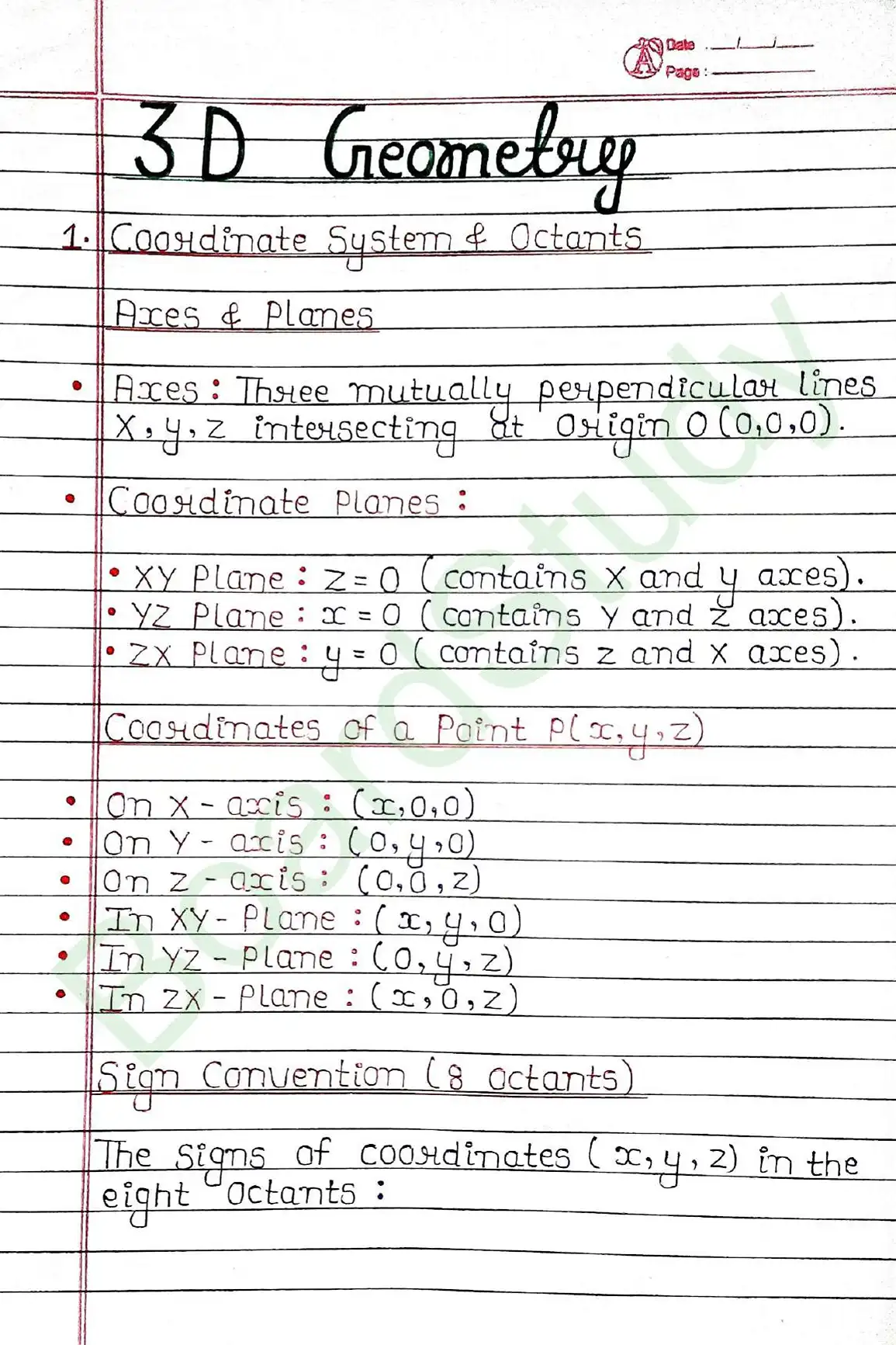
• Coordinate axes
In 3D, the coordinate axes of a rectangular cartesian coordinate system are three mutually perpendicular lines. These axes are called the X, Y and Z axes.
• Coordinate planes
The three planes determined by the pair of axes are the coordinate planes. These planes are called XY, YZ and ZX plane and they divide the space into eight regions known as octants.
• Coordinates of a point in space
The coordinates of a point in the space are the perpendicular distances from P on three mutually perpendicular coordinate planes YZ, ZX and XY respectively.
The coordinates of a point P are written in the form of triplet like (x, y, z).
The coordinates of any point on –
- X-axis is of the form (x, 0, 0)
- Y-axis is of the form (0, y, 0)
- Z-axis is of the form (0, 0, z)
- XY-plane are of the form (x, y, 0)
- YZ-plane are of the form (0, y, z)
- ZX-plane are of the form (x, 0, z)
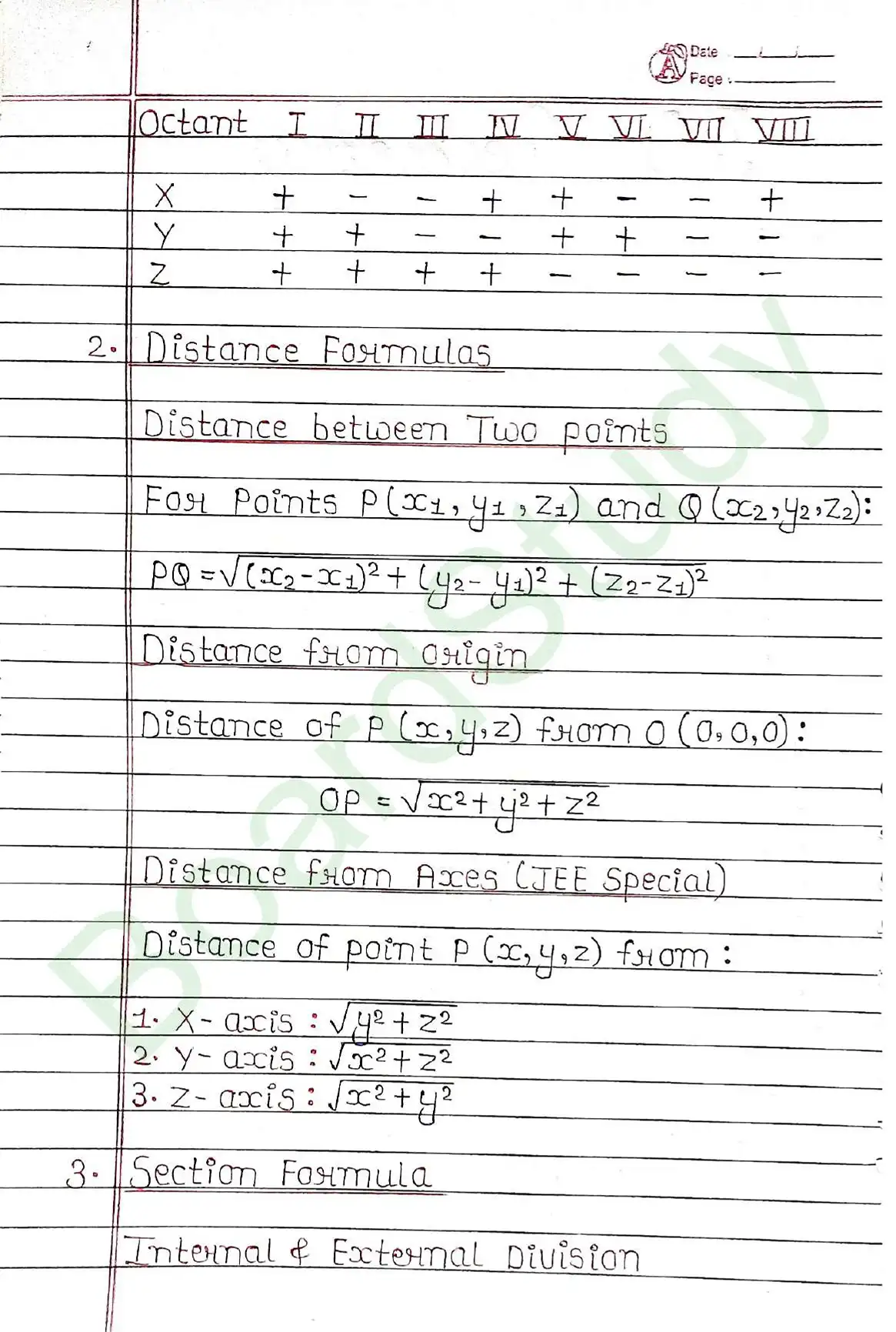
• Distance formula
The distance between two points P (x₁, y₁, z₁) and Q (x₂, y₂, z₂) is given by
The distance of a point P (x, y, z) from the origin O (0, 0, 0) is given by
• Section formula
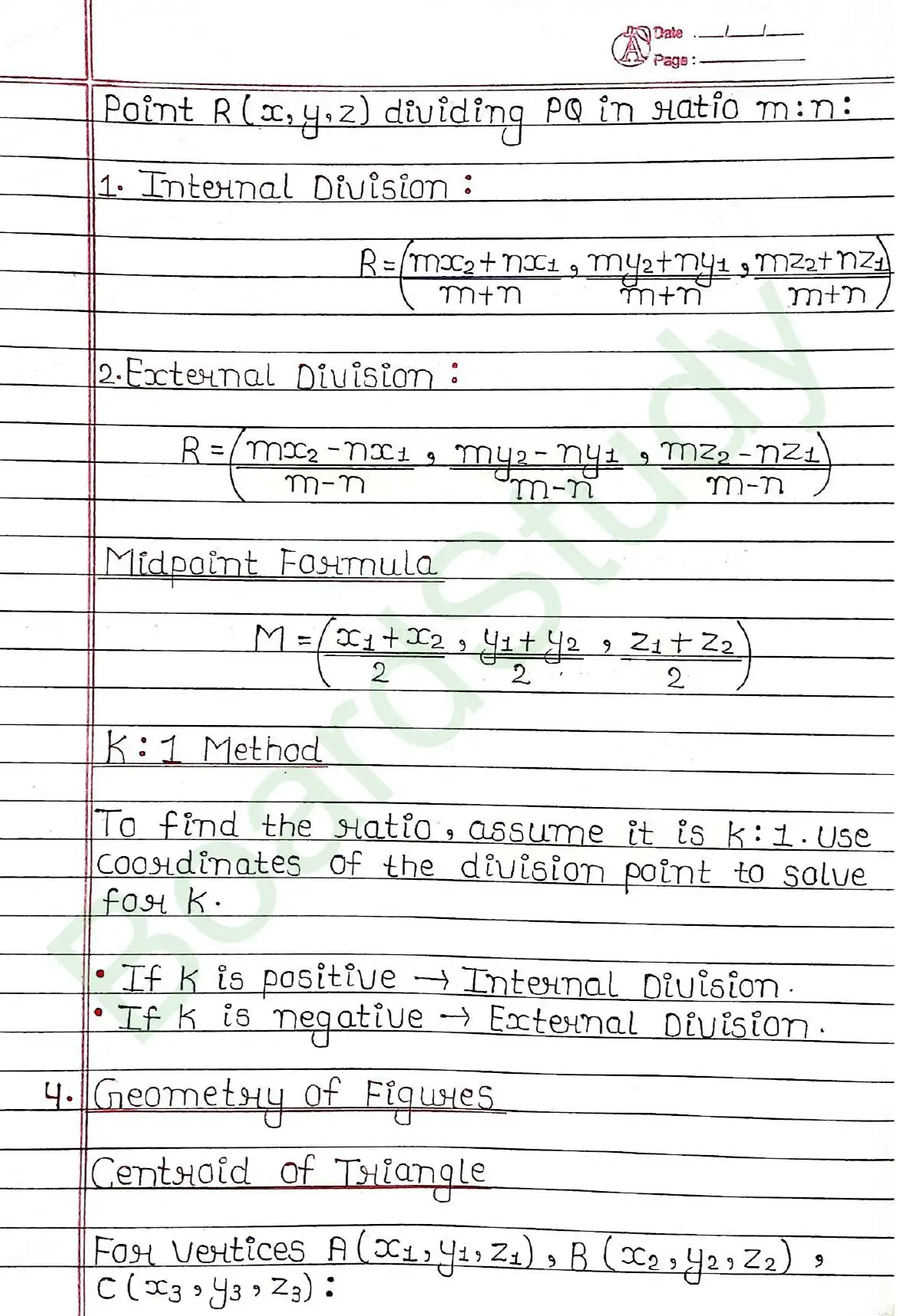
The coordinates of the point R which divides the line segment joining two points
P (x₁, y₁, z₁) and Q (x₂, y₂, z₂) internally or externally in the ratio m : n are given by –
(i) Internally
(ii) Externally
The coordinates of the point R which divides PQ in the ratio k : 1 are obtained by taking k = m/n which are as given below: