
BoardStudy given class 11 math set notes according to latest NCERT syllabus to make your study more convenient and easy. We have covered every topic in a simple and easy way so anyone can understand the chapter and perform well in the exam.
Notes are very clean and colourful written by BoardStudy subject matter experts. Every important concept, formula, diagram and derivation is shared in the Sets notes that will help you solve the problem. By reviewing these notes regularly you will master the sets chapter and can score well in exam.
Class 11 Math Sets Notes
Chapter 2: Relations and Functions Notes
Key Points
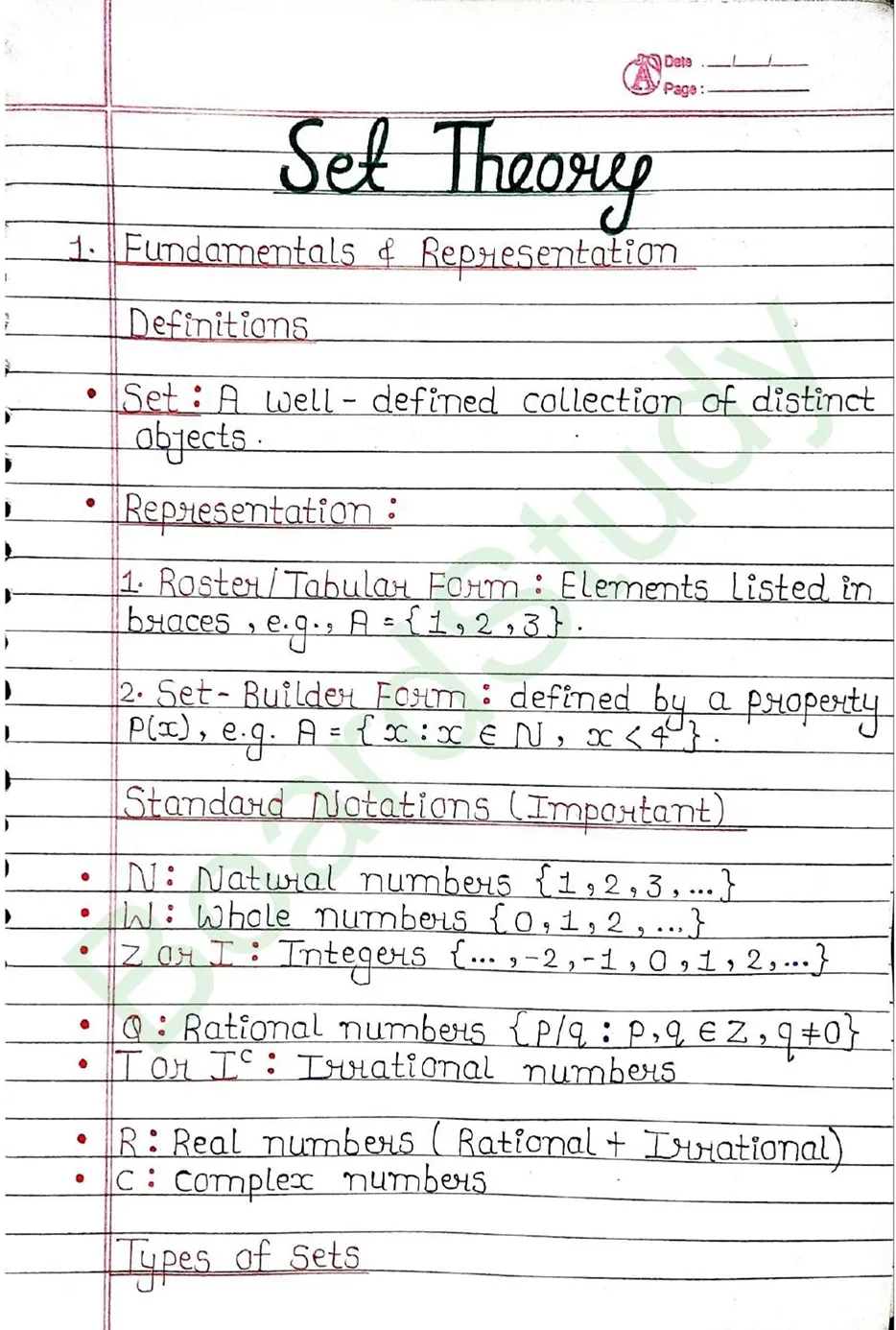
SETS
N : the set of all natural numbers
Z : the set of all integers
Q : the set of all rational numbers
R : the set of all real numbers
Z⁺ : the set of positive integers
Q⁺ : the set of positive rational numbers
R⁺ : the set of positive real numbers
NOTE:
- Objects, elements and members of a set are synonymous terms.
- Sets are usually denoted by capital letters A, B, C, V etc.
- The elements of a set are represented by small letters a, b, c, x, y, z etc.
Two methods of representing a set:
(i) Roster or tabular form
All elements of a set are listed. The elements are separated by commas and are enclosed within braces { }.
Ex – The set of all vowels in English alphabet is
V = {a, e, i, o, u}
(ii) Set builder form
All the elements of a set possess a single common property which is not possessed by any element outside the set.
Ex –
V = { x : x is a vowel in English alphabet }
Set is a well defined collection of objects.
Types of sets
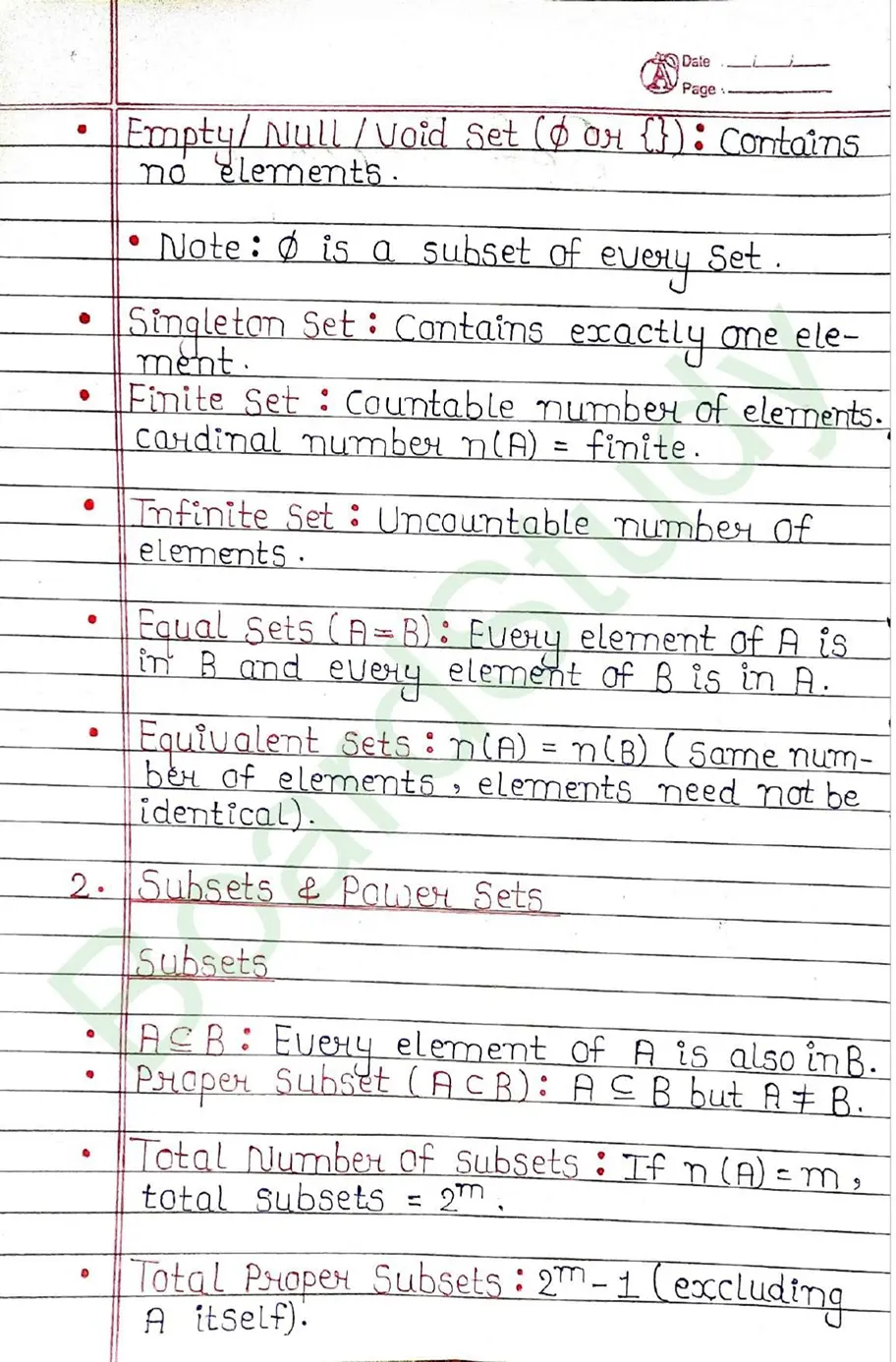
- Empty set – A set which does not contain any element is called an empty set or void set or null set and it is denoted by { } or ϕ.
- Singleton set – A set consists of a single element.
- Finite or infinite set –
A set which consists of a finite number of elements is called a finite set, otherwise the set is called an infinite set. - Equal sets –
Two sets A and B are said to be equal if every element of A is also an element of B or vice-versa. - Equivalent sets –
Two finite sets A and B are said to be equivalent if the number of elements are equal i.e.
n(A) = n(B)
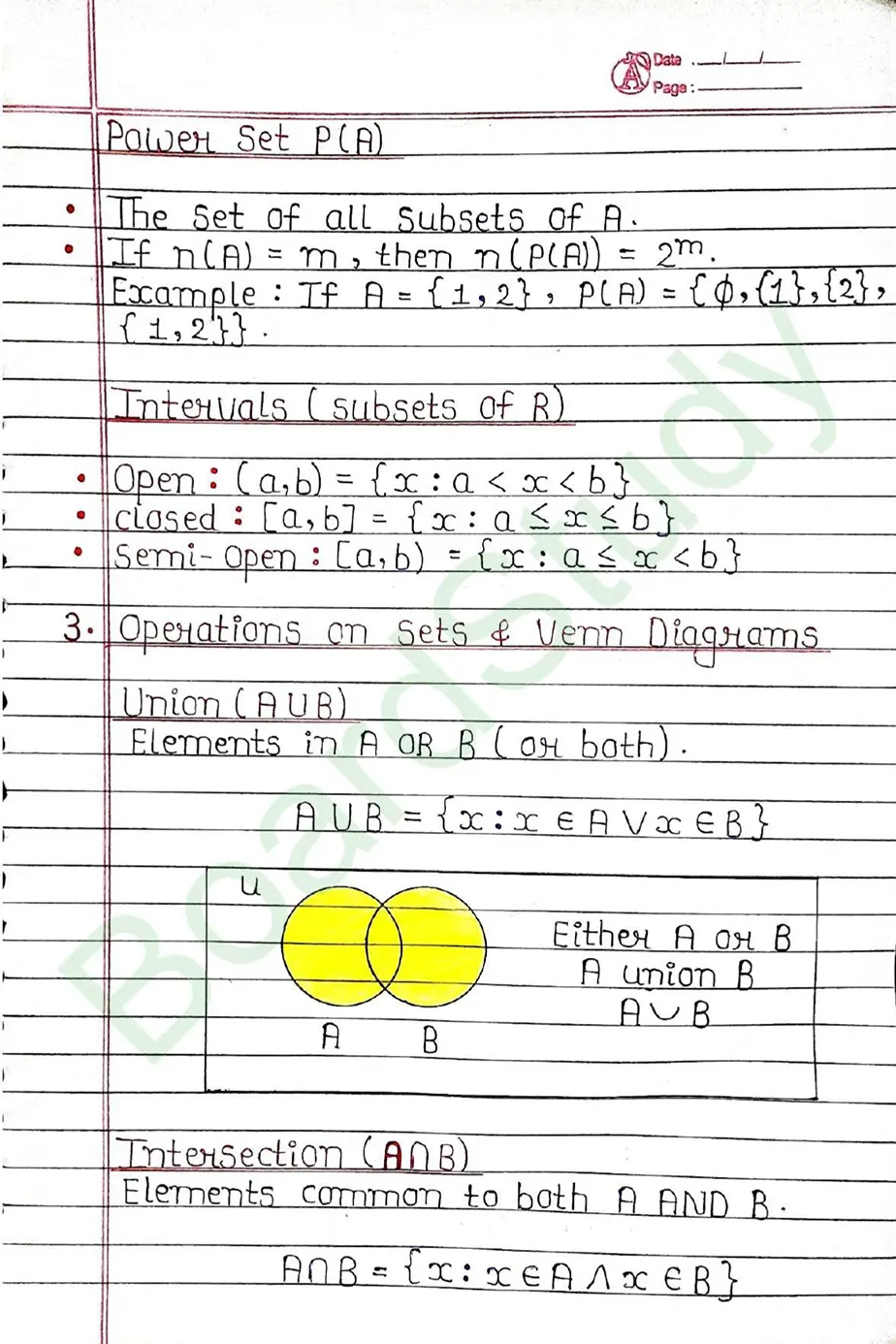
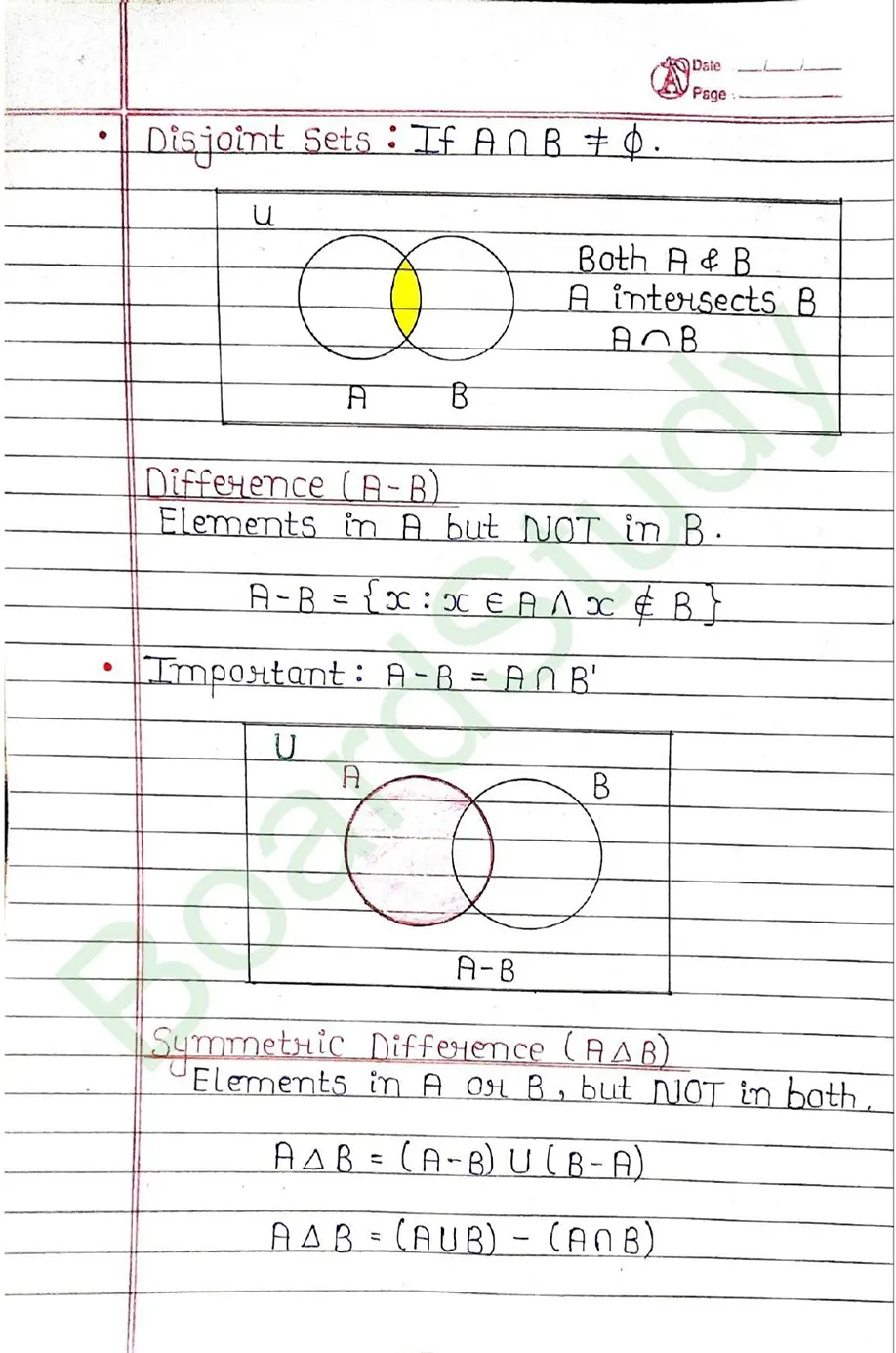
Venn diagrams
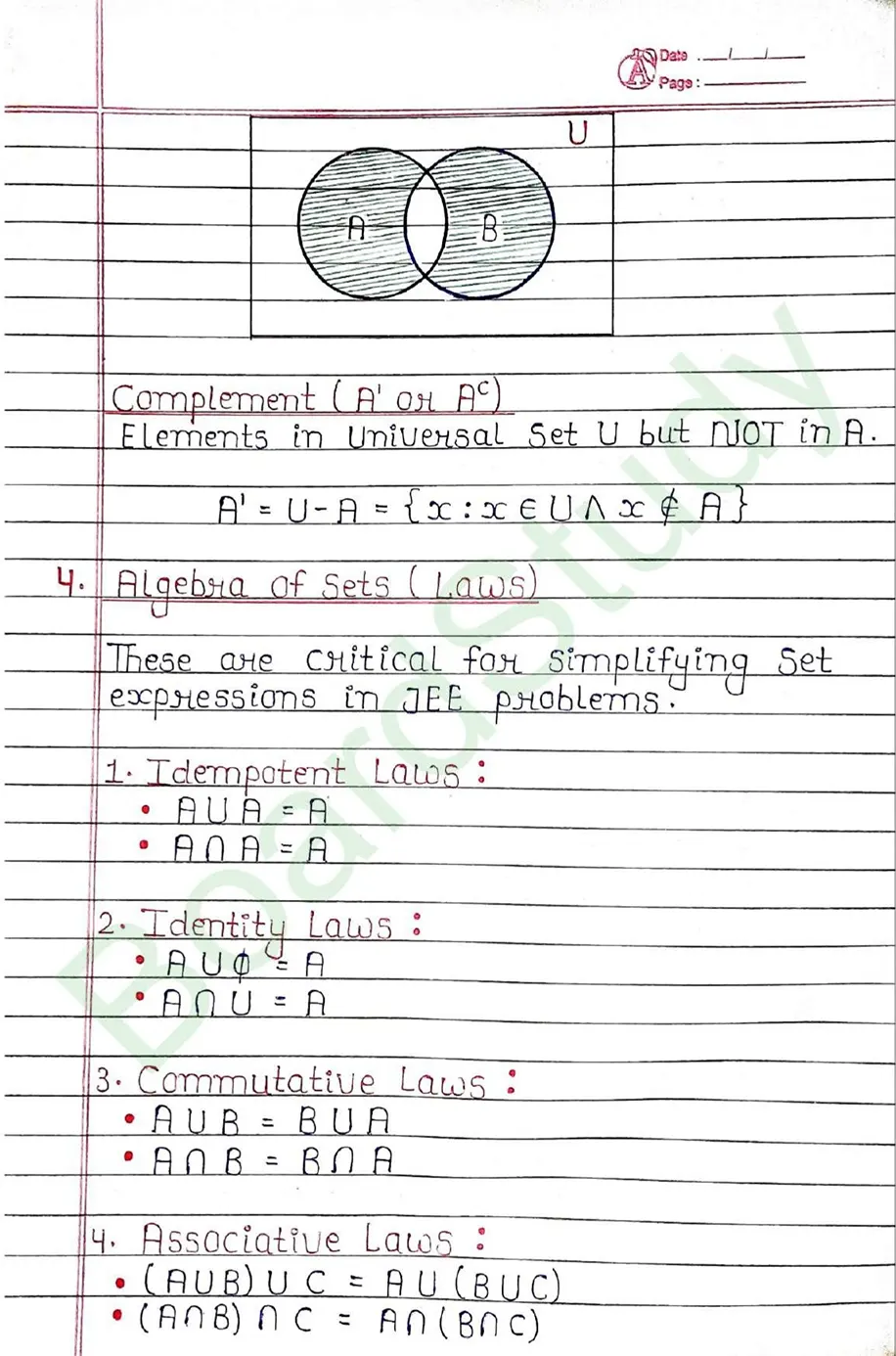
Venn diagrams are the diagrams which represent the relationship between sets.
In Venn diagrams the universal set U is represented by points within a rectangle and its subsets are represented by points in closed curves (usually circles) within the rectangle.