
Some students find Math a very hard subject so here on BoardStudy, we have shared class 11 Math Chapter 14 Probability notes PDF. We have covered every topic in a simple and easy way so anyone can understand the chapter and perform well in exam.
Notes are very clean and colourful written by BoardStudy subject matter experts. Every important concept, formula, diagram and derivation is shared in the Probability notes that will help you solve the problem. By reviewing these notes regularly you will master the Probability chapter and can score well in exam.
Probability Handwritten Notes PDF

Chapter 13: Statistics Notes
Key Points Probability
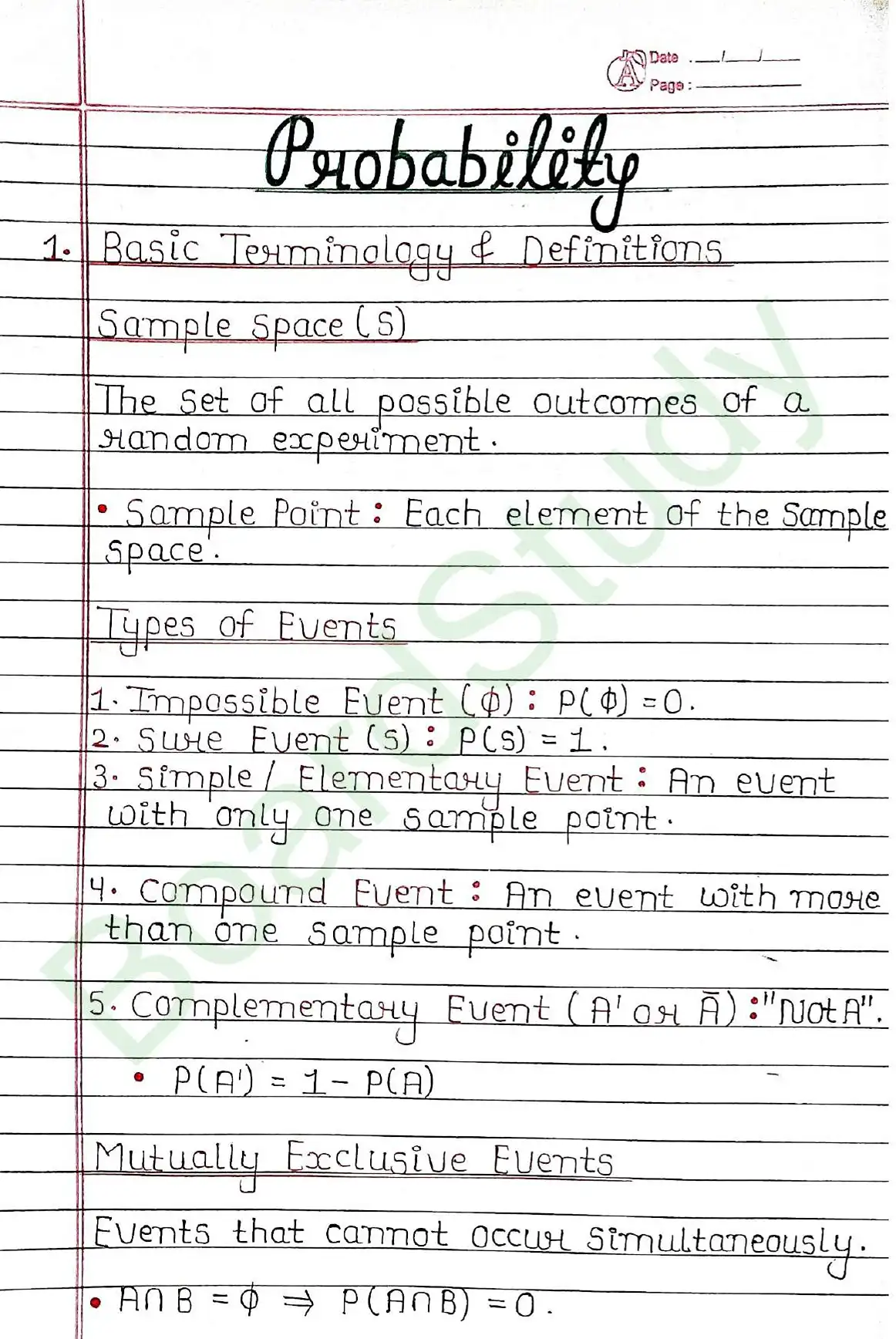
Probability
• Random experiment – An experiment whose outcomes cannot be predicted or determined in advance is called a random experiment.
• Outcome – A possible result of a random experiment is called its outcome.
• Sample space – The set of all possible outcomes.
• Sample points – Elements of sample space.
• Events – An event is a subset of a sample space associated with a random experiment.
Types of events
• Impossible events – The empty set.
• Sure events – The whole sample space.
• Complementary event or not event – The set A′ or S − A.
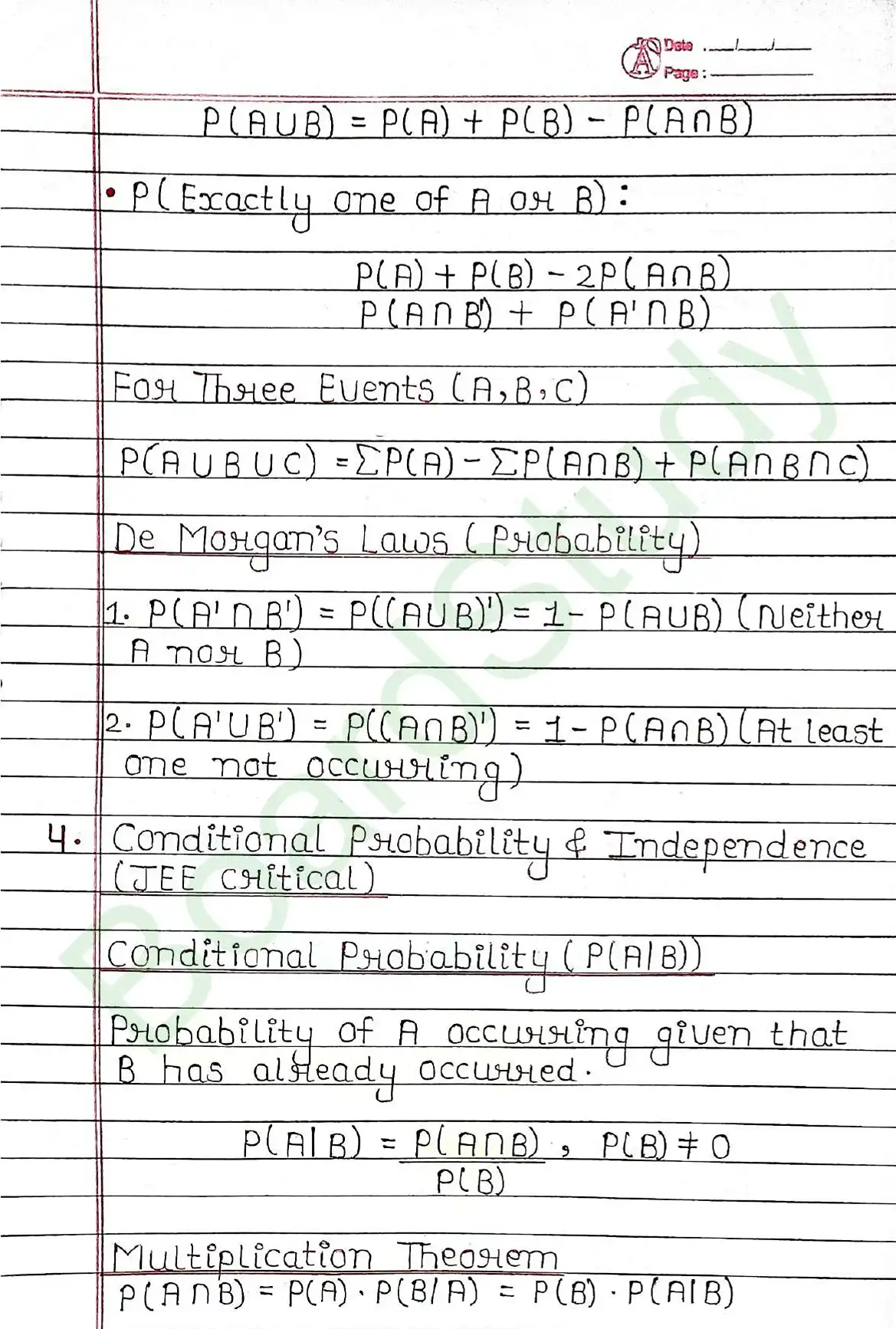
Event A or B : The set A ∪ B
Event A and B : The set A ∩ B
Event A and not B : The set A − B
• Mutually exclusive event
A and B events are mutually exclusive if both events cannot occur simultaneously, i.e.
A ∩ B = φ or
P(A ∩ B) = 0
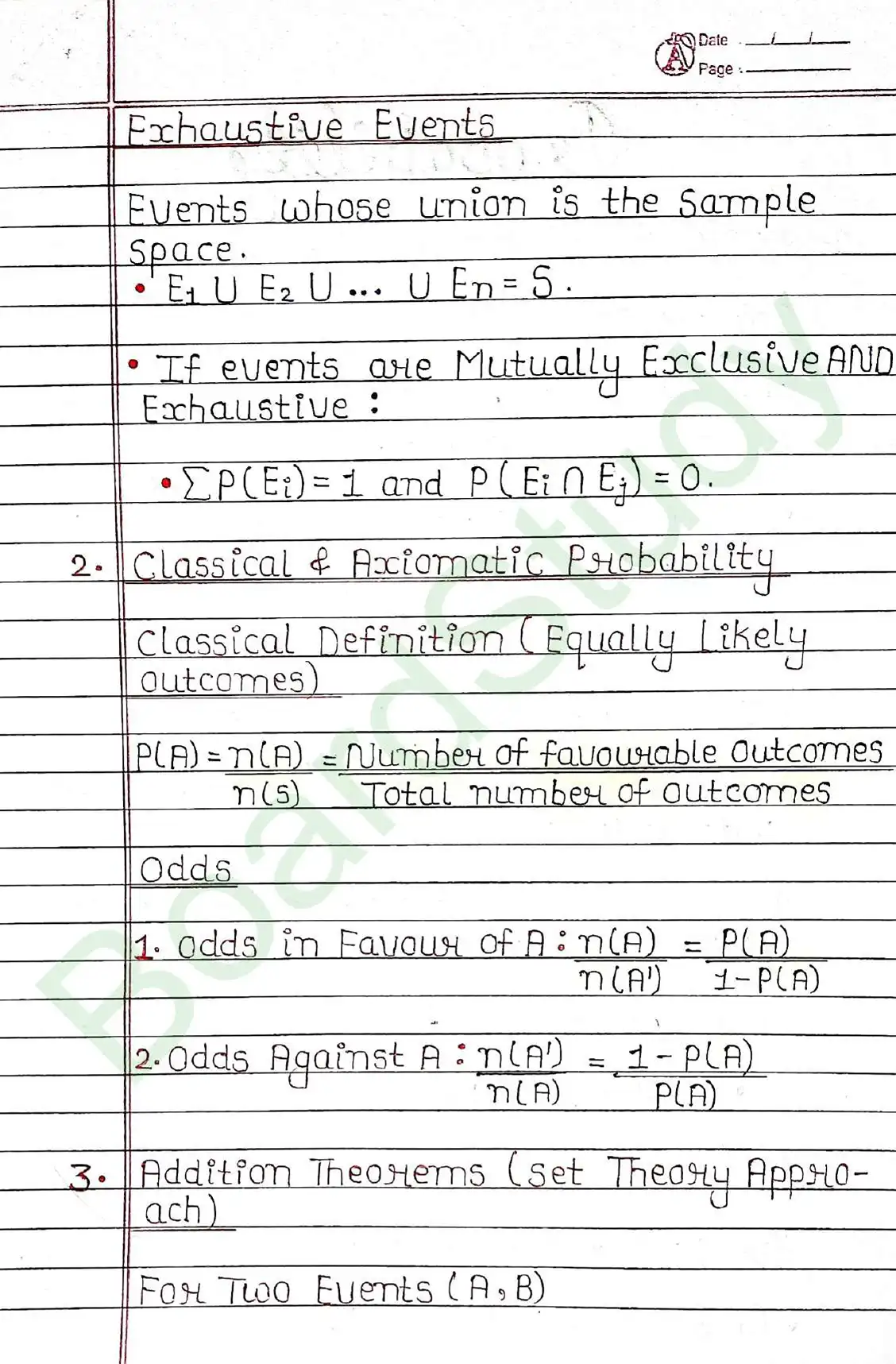
• Exhaustive events
If E₁, E₂, … En are n events of a sample space S and if
E₁ ∪ E₂ ∪ E₃ ∪ … ∪ En = S
then E₁, E₂, … En are called exhaustive events.
• Exhaustive and mutually exclusive events
Events E₁, E₂, … En are mutually exclusive and exhaustive if
E₁ ∪ E₂ ∪ … ∪ En = S
and
Eᵢ ∩ Eⱼ = φ ∀ i ≠ j
• Probability
Let S = {ω₁, ω₂, … ωn} be the sample space associated with a random experiment. Then, a function P which assigns every event A ⊆ S to a unique non-negative real number P(A) is called the probability function.
Number P(ωᵢ) associated with sample point ωᵢ such that:
(i) 0 ≤ P(ωᵢ) ≤ 1 for each ωᵢ ∈ S
(ii) Σ P(ωᵢ) = 1 (for all ωᵢ ∈ S)
(iii) P(A) = Σ P(ωᵢ) for all ωᵢ ∈ A
The number P(ωᵢ) is called probability of the outcome ωᵢ.