
Some students find Math a very hard subject so here on BoardStudy, we have shared class 12 Math Chapter 14 Probability notes. We have covered every topic in a simple and easy way so anyone can understand the chapter and perform well in exam.
Notes are very clean and colourful written by BoardStudy subject matter experts. Every important concept, formula, diagram and derivation is shared in Probability Notes notes that will help you solve the problem. These notes are designed to make complex topics easier which will definitely boost the students’ confidence during the exam.
Probability Notes Notes PDF
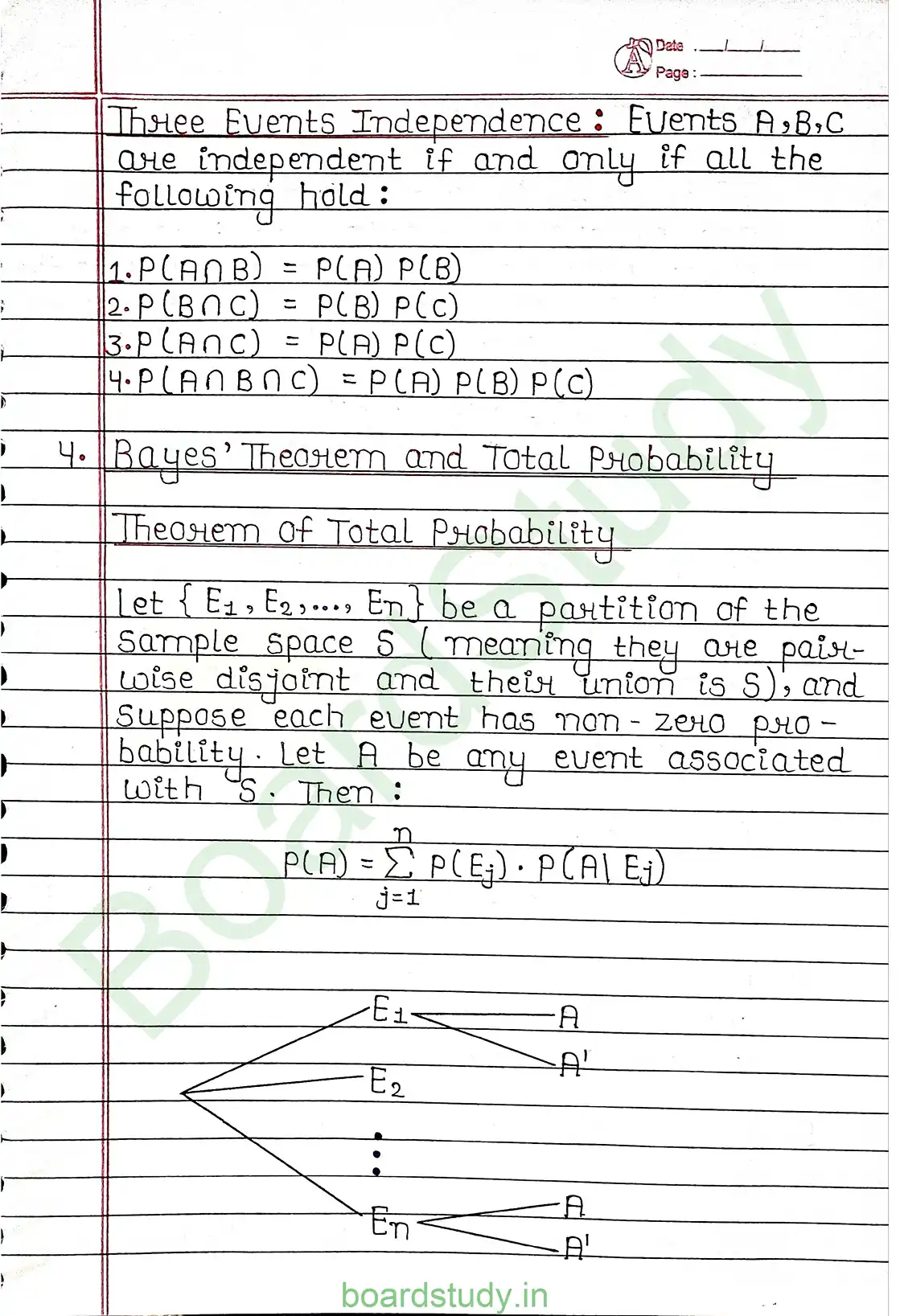
Chapter 12: Linear Programming
Other Subjects:
Class 12 Physics Notes PDF
Class 12 Chemistry Notes PDF
Key Points
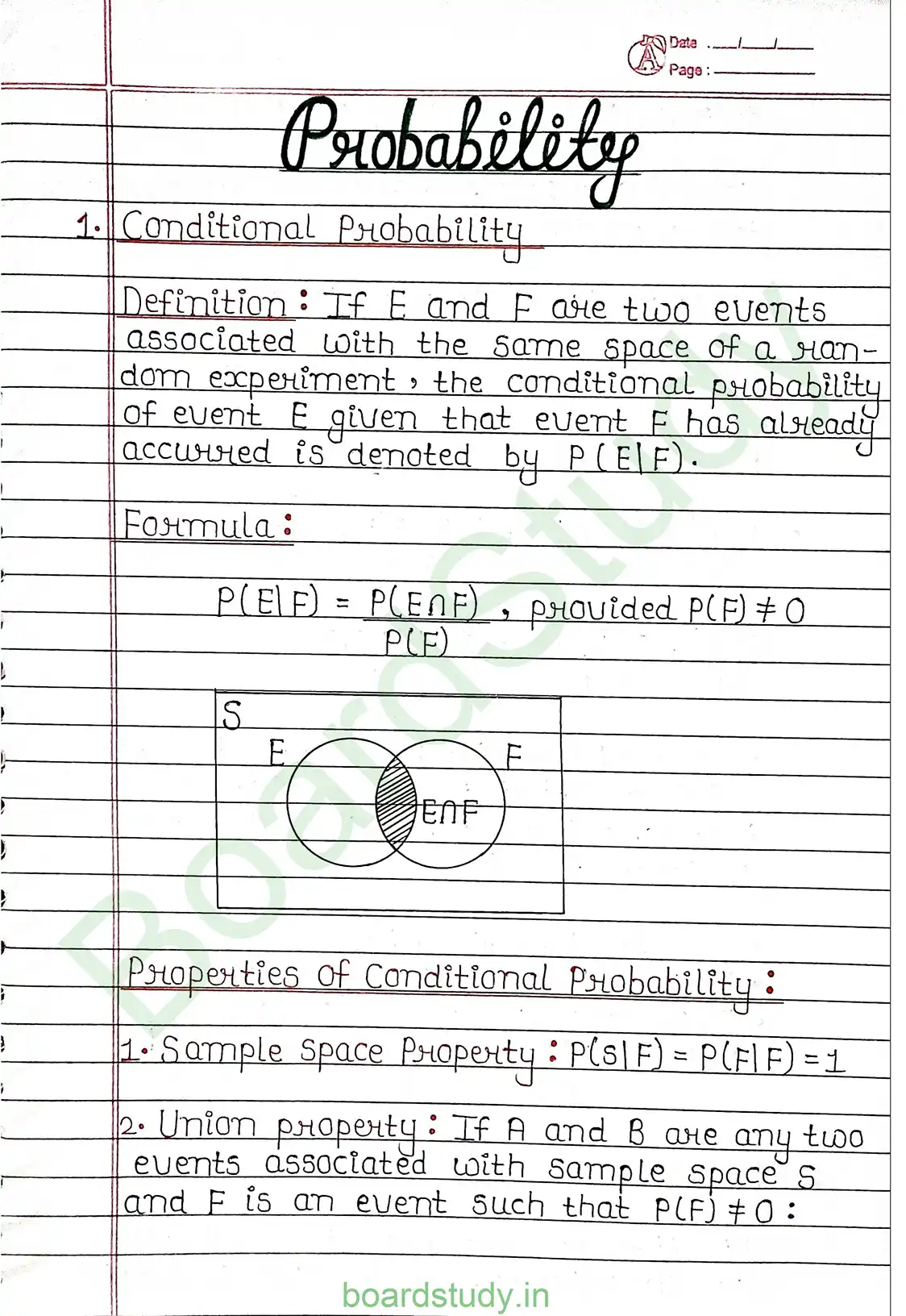
1. Conditional Probability
Definition : If E and F are two events associated with the same space of a random experiment , the conditional probability of event E given that event F has already occurred is denoted by P(E|F).
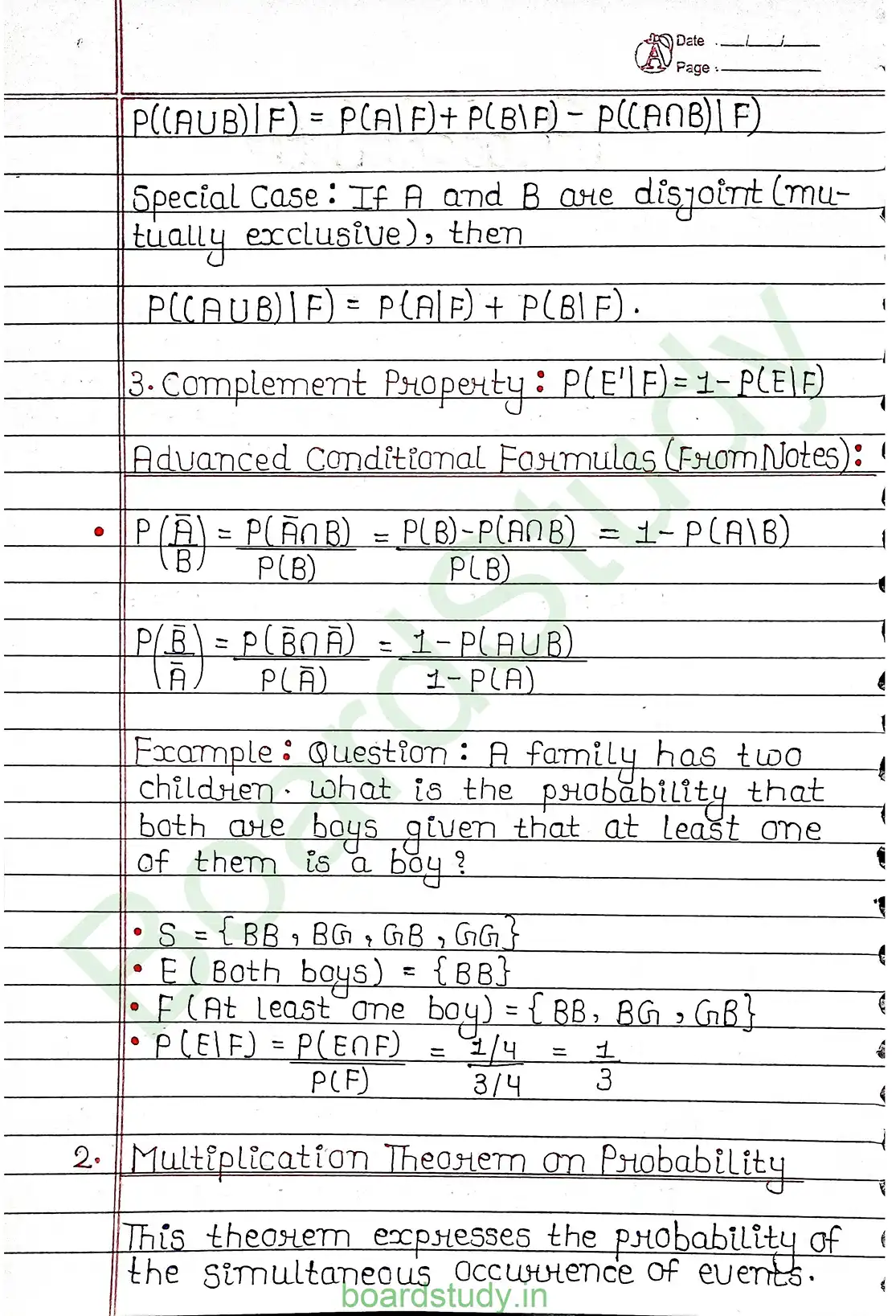
2. Multiplication Theorem on Probability
This theorem expresses the probability of the simultaneous occurrence of events.
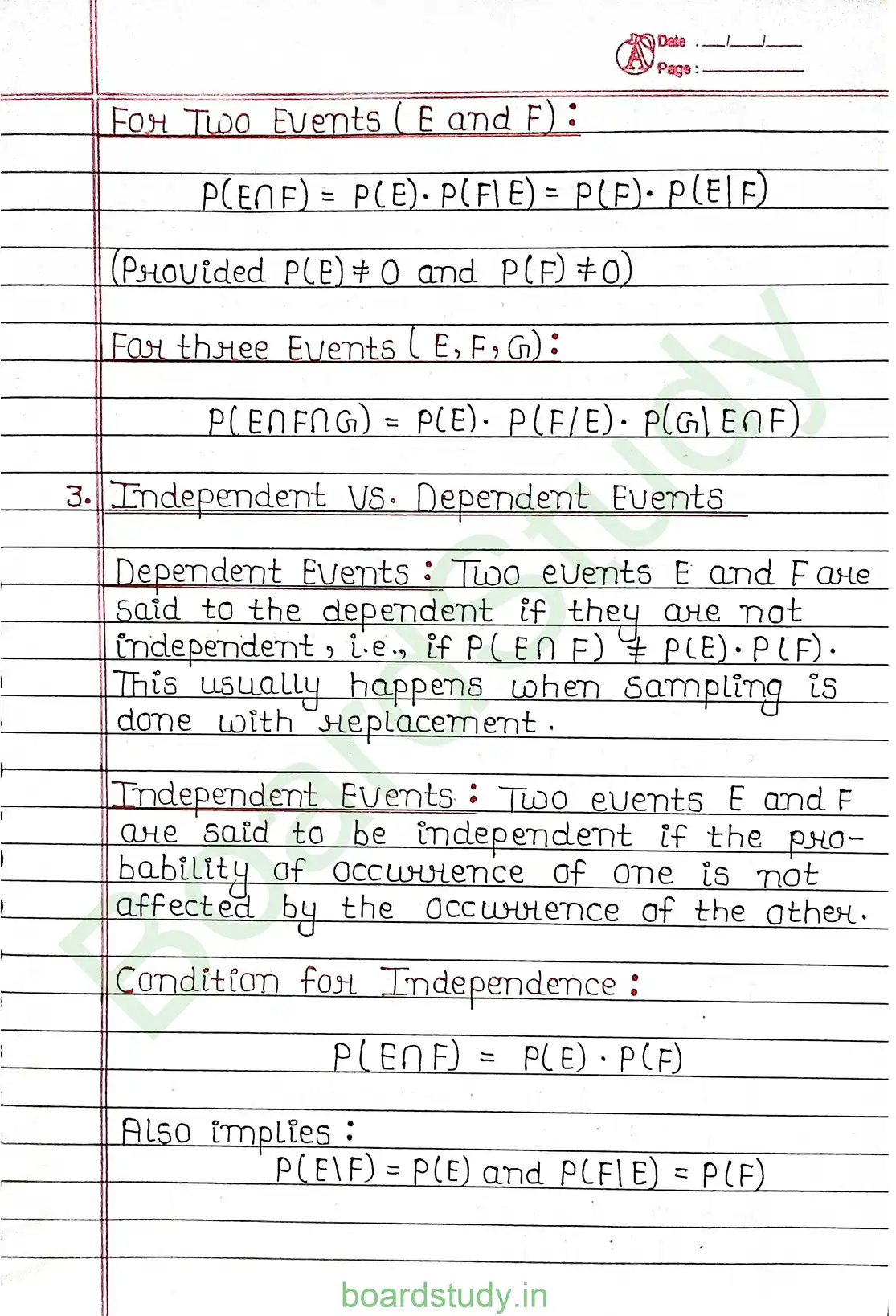
3. Independent vs. Dependent Events
Dependent Events : Two events E and F are said to the dependent if they are not independent , i.e. , if P(E ∩ F) ≠ P(E) · P(F). This usually happens when sampling is done with replacement .
Independent Events : Two events E and F are said to be independent if the probability of occurrence of one is not affected by the occurrence of the other.
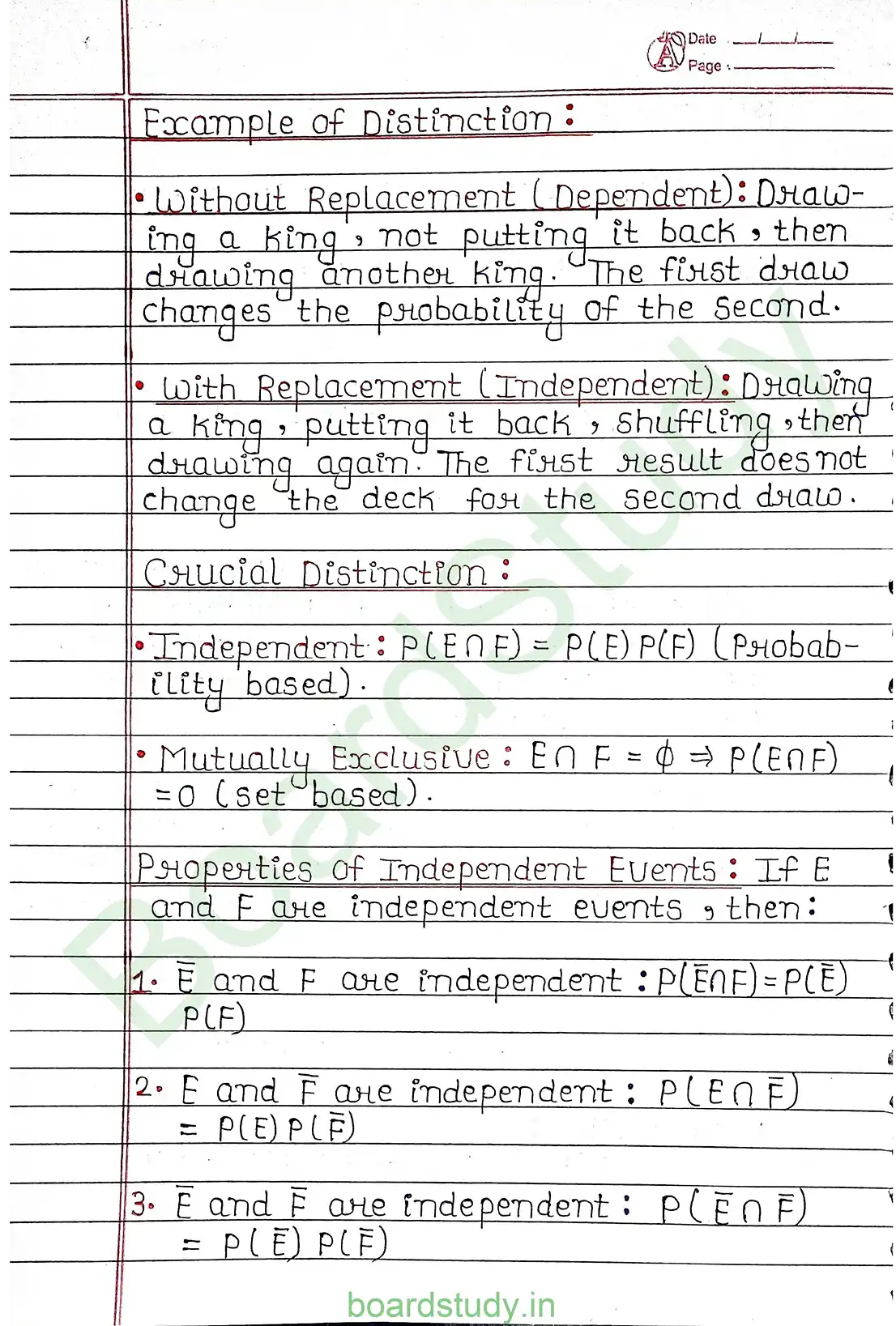
Example of Distinction :
• Without Replacement (Dependent) : Drawing a king , not putting it back , then drawing another king . The first draw changes the probability of the second.
• With Replacement (Independent) : Drawing a king , putting it back , shuffling , then drawing again . The first result does not change the deck for the second draw.
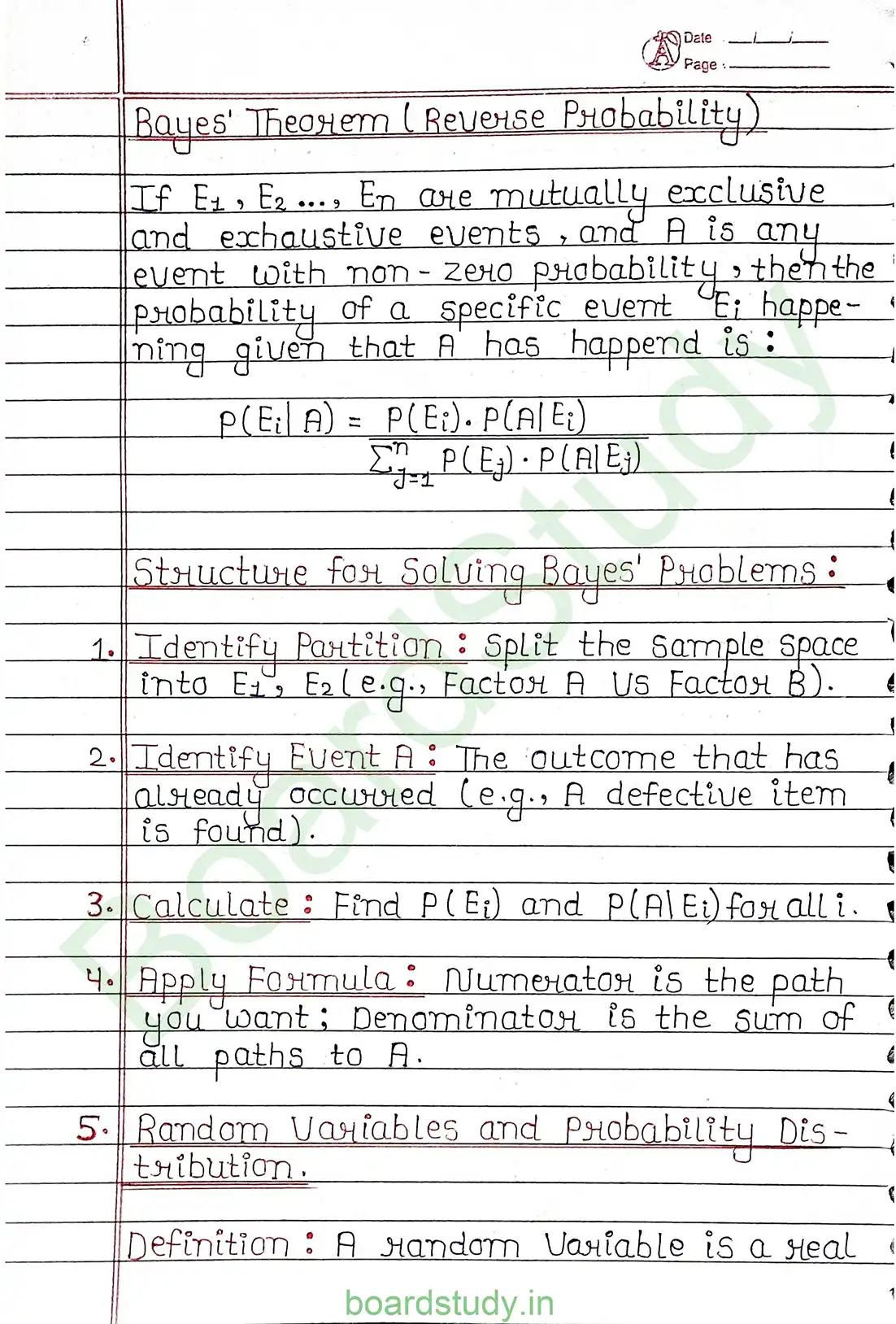
Structure for Solving Bayes’ Problems :
1. Identify Partition : Split the sample space into E₁ , E₂ (e.g. , Factory A vs Factory B).
2. Identify Event A : The outcome that has already occurred (e.g. , A defective item is found).
3. Calculate : Find P(Eᵢ) and P(A|Eᵢ) for all i.
4. Apply Formula : Numerator is the path you want ; denominator is the sum of all paths to A.
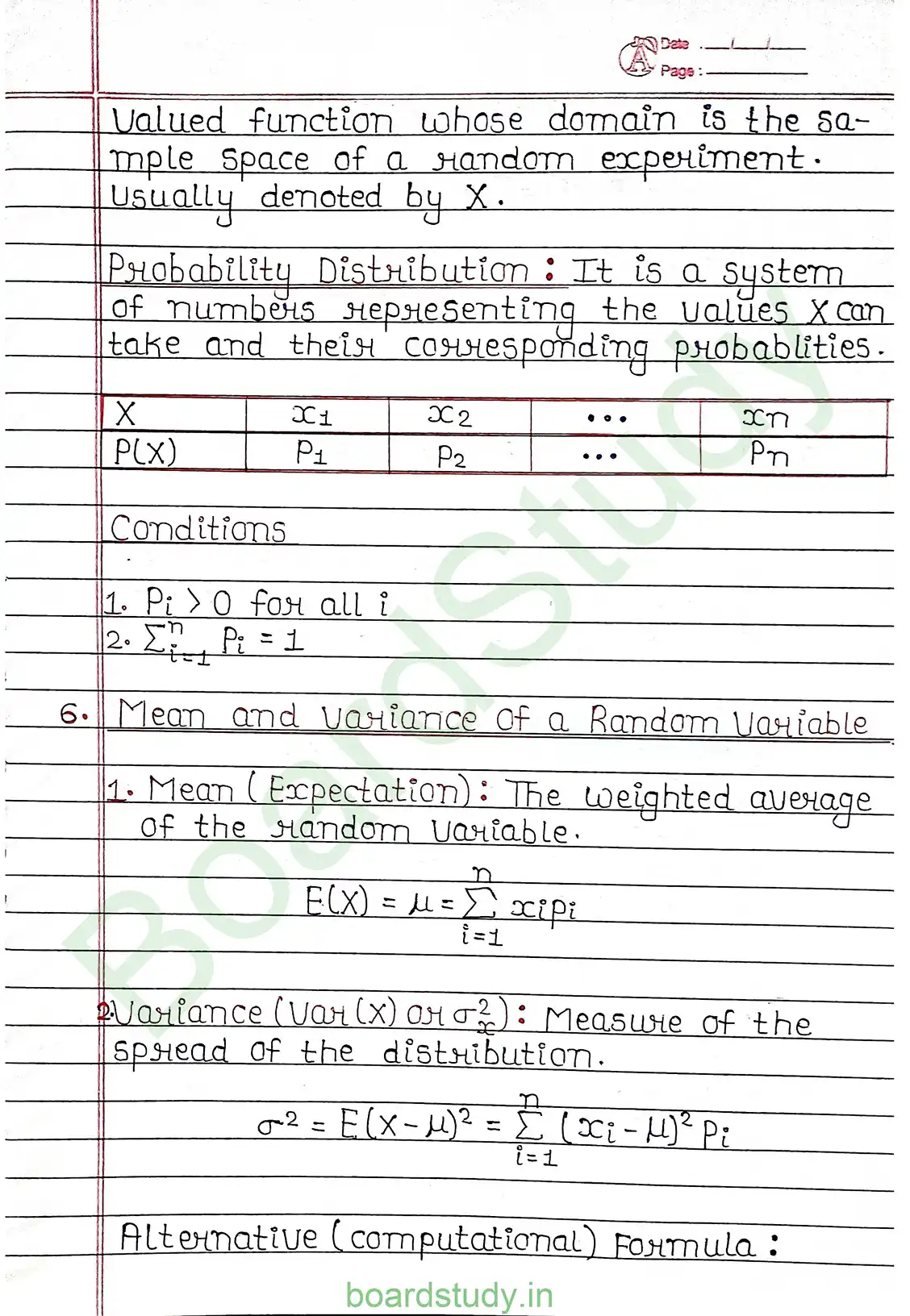
5. Random Variables and Probability Distribution
Definition : A random variable is a real Valued function whose domain is the sample space of a random experiment .
Usually denoted by X.
Probability Distribution : It is a system of numbers representing the values X can take and their corresponding probabilities.
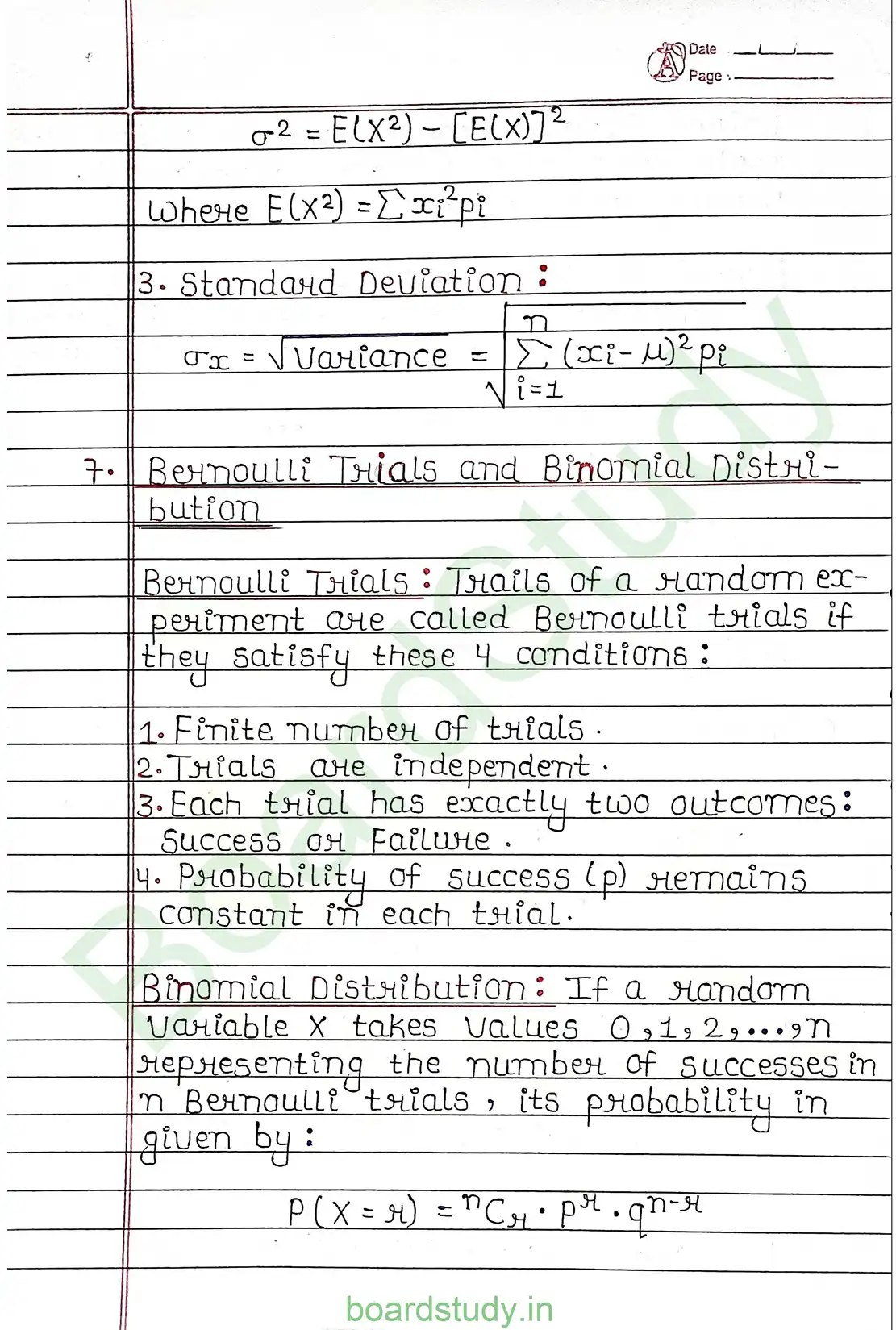
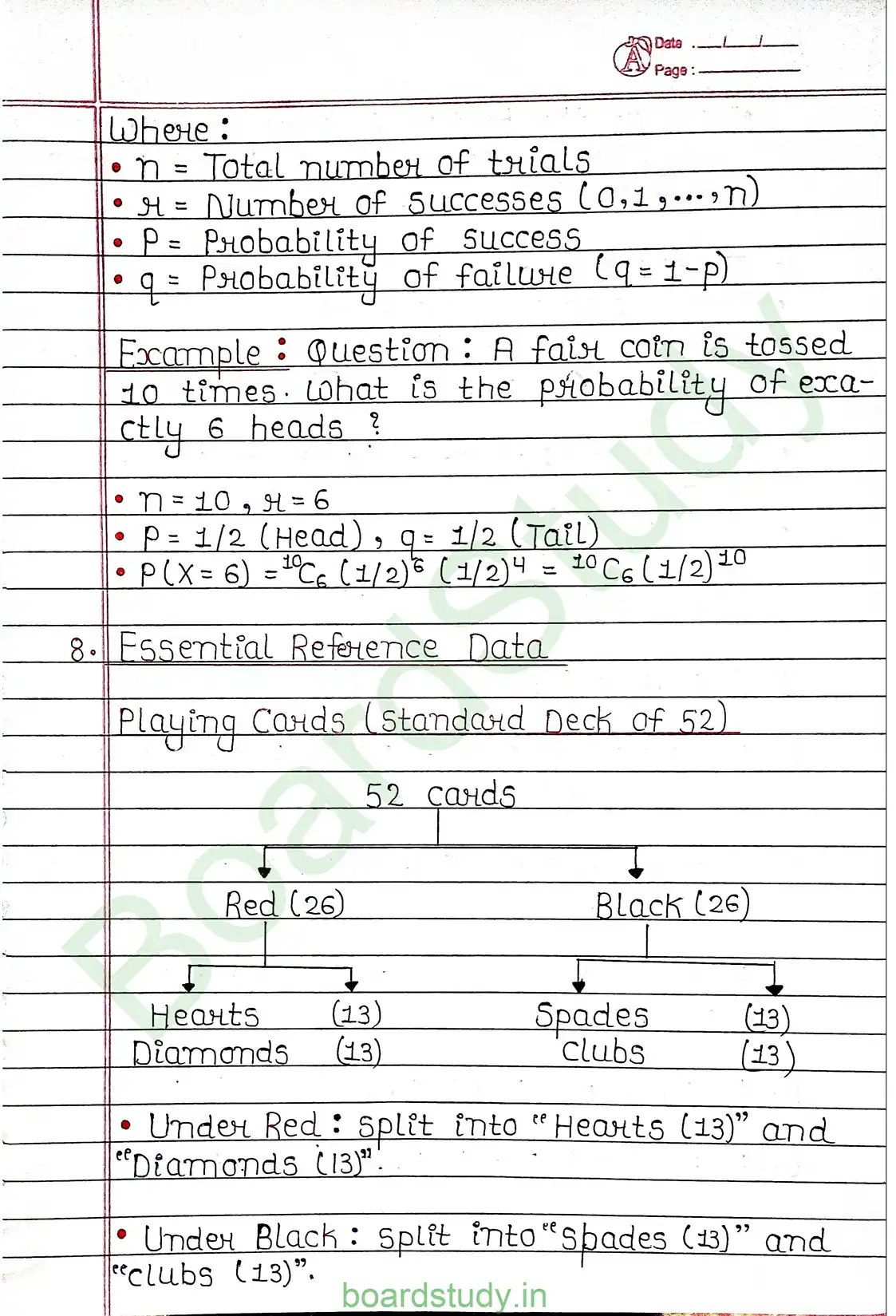
7. Bernoulli Trials and Binomial Distribution
Bernoulli Trials : Trials of a random experiment are called Bernoulli trials if they satisfy these 4 conditions :
- Finite number of trials .
- Trials are independent .
- Each trial has exactly two outcomes : Success or Failure .
- Probability of success (p) remains constant in each trial.