
Mathematics can be both fantastic and challenging at the same time. Specially in class 10 when students have to give board paper. So our NCERT class 10 Mathematics Chapter 8 Introduction to Trigonometry notes will provide conceptual clarity to the students. It will work like a bridge for students between class room theory lecture and solving exercise at home.
These Class 10 Chapter 8 Introduction to Trigonometry Notes is a masterstroke for students who want to pursue a career in science, like becoming an engineer, scientist etc. Most of the concept given in class 11 maths have already been introduced in class 10 maths. So these notes are also the foundation of class 11 math.
Class 10 Maths Chapter 8 Introduction to Trigonometry Notes
Chapter 7: Coordinate Geometry Notes
Chapter 9: Some Applications of Trigonometry Notes
Below we have also given most important topics of NCERT Class 10 Mathematics chapter 8 Introduction to Trigonometry Notes. Students should revise these notes regularly to remember the chapter properly.
Important Topics of Introduction to Trigonometry
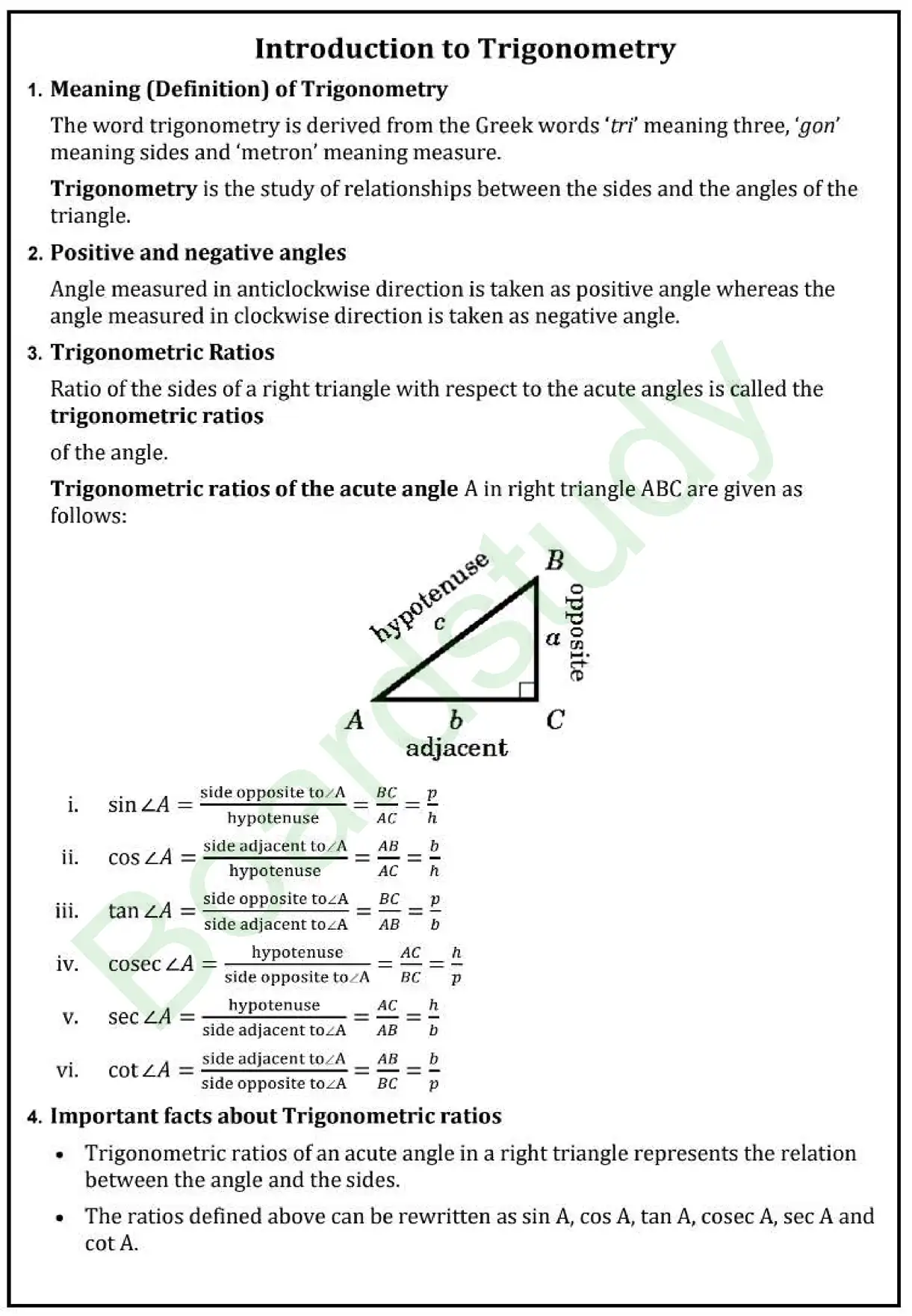
Important facts about Trigonometric ratios
- Trigonometric ratios of an acute angle in a right triangle represents the relation between the angle and the sides.
- The ratios defined above can be rewritten as
- Each trigonometric ratio is a real number and it has not unit.
- All the trigonometric symbols i.e., cosine, sine, tangent, cotangent, secant and cosecant, have no literal meaning.
- (\sin θ)^n is generally written as sin^n θ, n being a positive integer. Similarly, other trigonometric ratios can also be written.
- The values of the trigonometric ratios of an angle do not vary with the length of the sides of the triangle, if the angles remain the same.
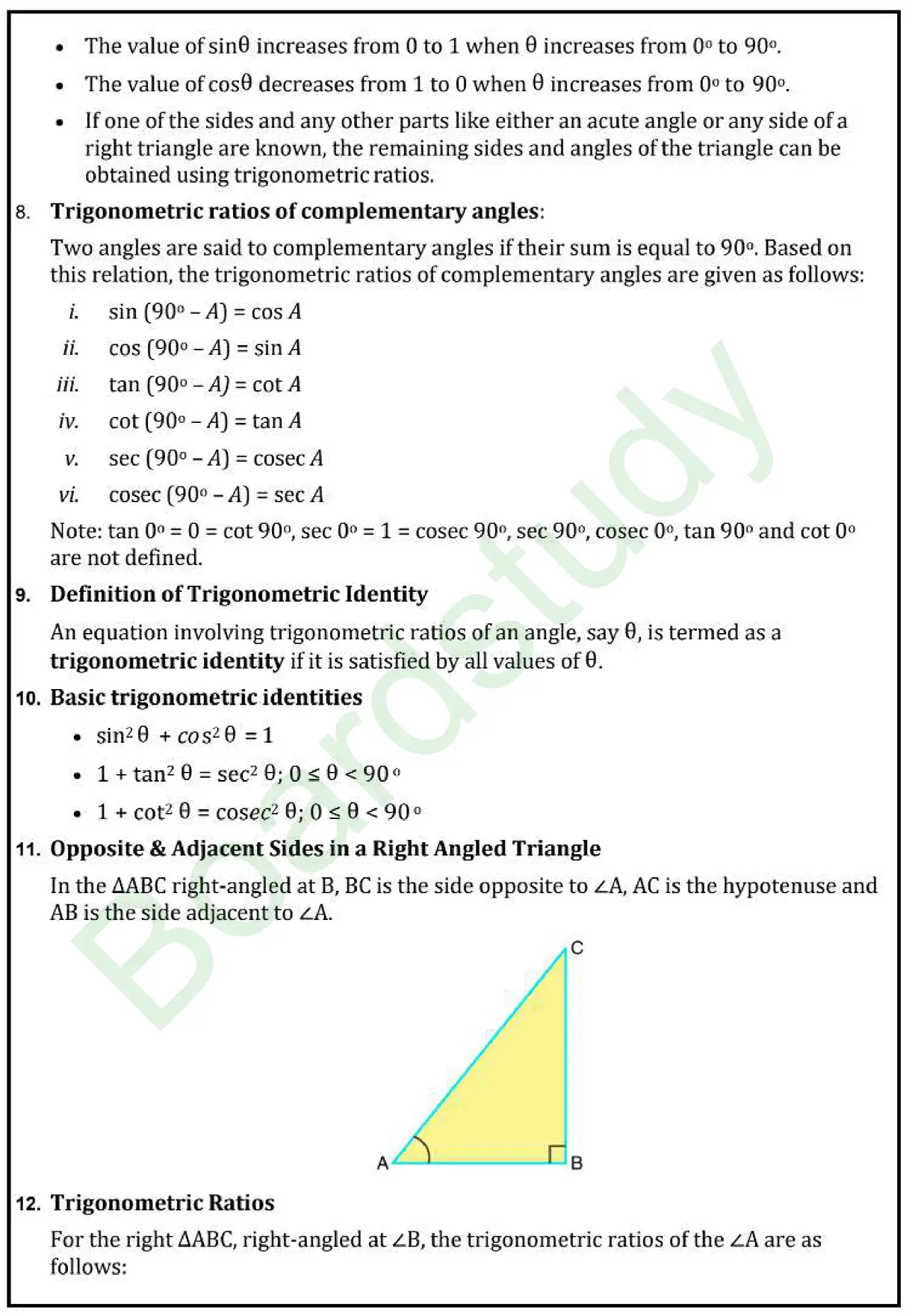
Pythagoras theorem:
It states that “in a right triangle, square of the hypotenuse is equal to the sum of the squar es of the other two sides”.
Pythagoras theorem can be used to obtain the length of the side of a right angled triangle when the other two sides are already given.
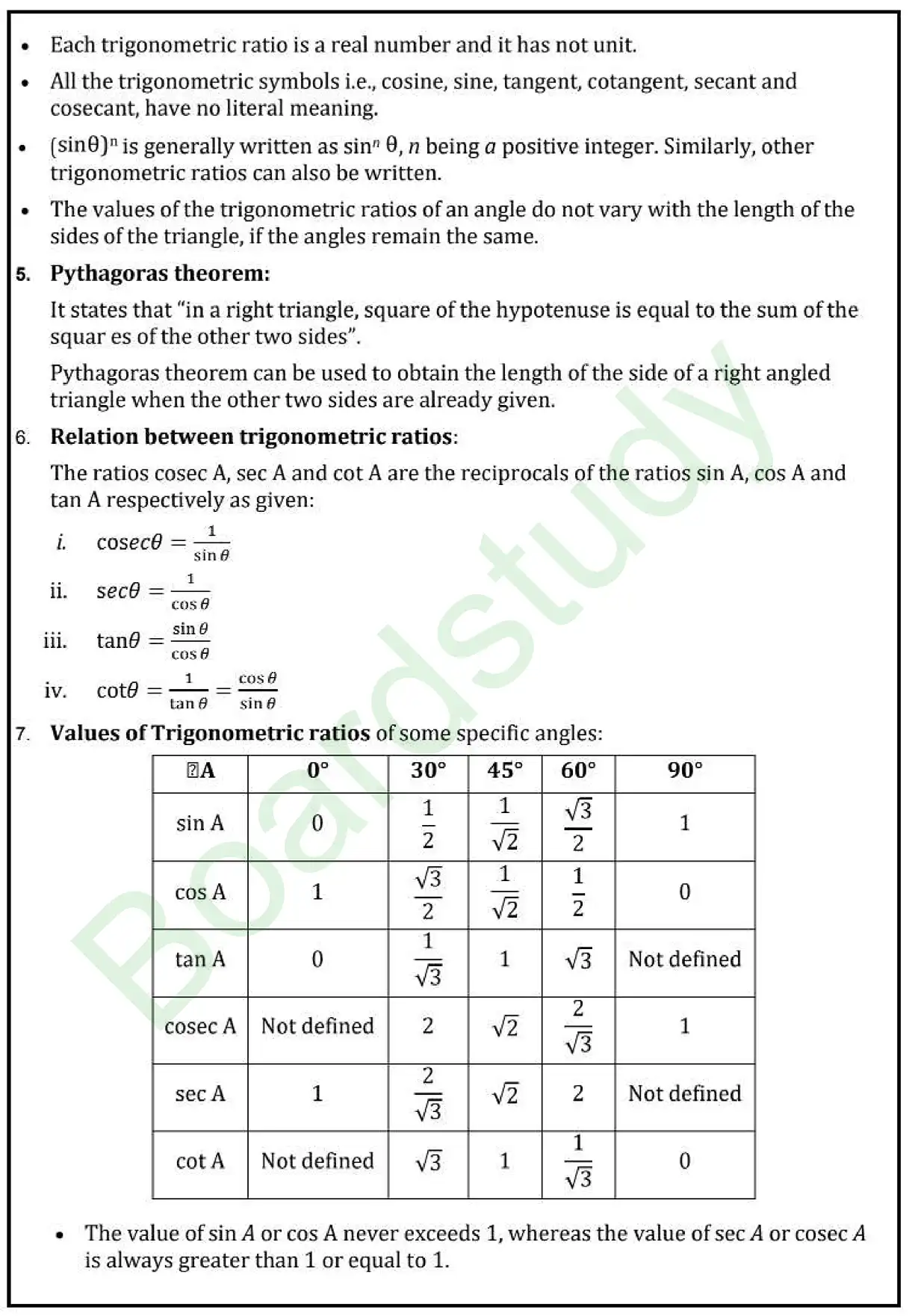
Values of Trigonometric ratios of some specific angles: